
Direct answer: Separate the customer-research job from the operational-pricing job. Use Van Westendorp to establish a plausible price range, Gabor-Granger to test price points within that range, and conjoint when feature or package trade-offs matter. Choose a self-serve research platform when the team expects to repeat studies, a consultant when the work has unusual complexity or needs external validation, and enterprise CPQ when the need is downstream quote and price-rule enforcement.
Start With the Pricing Decision, Not the Vendor Category
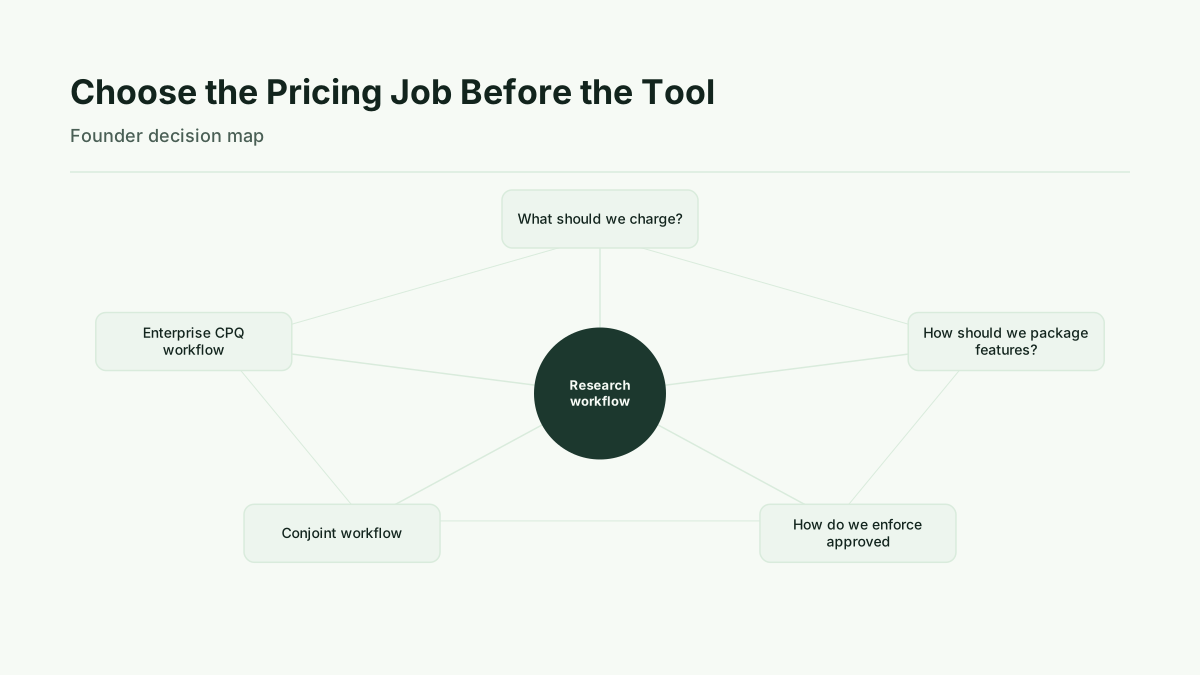
A founder deciding what customers may pay has a different workflow from an enterprise team enforcing approved prices through quote-to-cash operations. That distinction is the starting point for evaluating a Vendavo alternative.
First classify the job. If the question is “What should we charge?”, the work is customer-facing pricing research. If the question is “How should we package features?”, the work is package or feature trade-off research. If the question is “How do we enforce approved prices?”, the work is operational price execution. These jobs can connect, but they should not be treated as interchangeable.
A research platform helps investigate an uncertain offer or price. A consultant can add external perspective when the decision is unusually complex or high-stakes. An enterprise CPQ platform belongs in the comparison when the organization needs quote and price-rule operations. The right alternative therefore depends less on the vendor label than on the decision that must be made.
Match Van Westendorp, Gabor-Granger, and Conjoint to the Question
Method: Select the smallest method that answers the decision. Van Westendorp uses four price perceptions to estimate an acceptable price range and an optimal price point. It is the range-discovery step when the team does not yet know which prices customers may consider acceptable.
Gabor-Granger tests stated purchase likelihood at specified prices. Those responses can be used to construct demand and modeled revenue curves, making the method useful when the team has candidate prices and wants to compare them. Its output remains a model based on stated likelihood, not observed revenue.
Conjoint presents product configurations with different feature and price combinations. It estimates relative utilities and supports decisions about package or feature trade-offs. Use it when the central uncertainty is not only the price, but also what should be included in each offer.
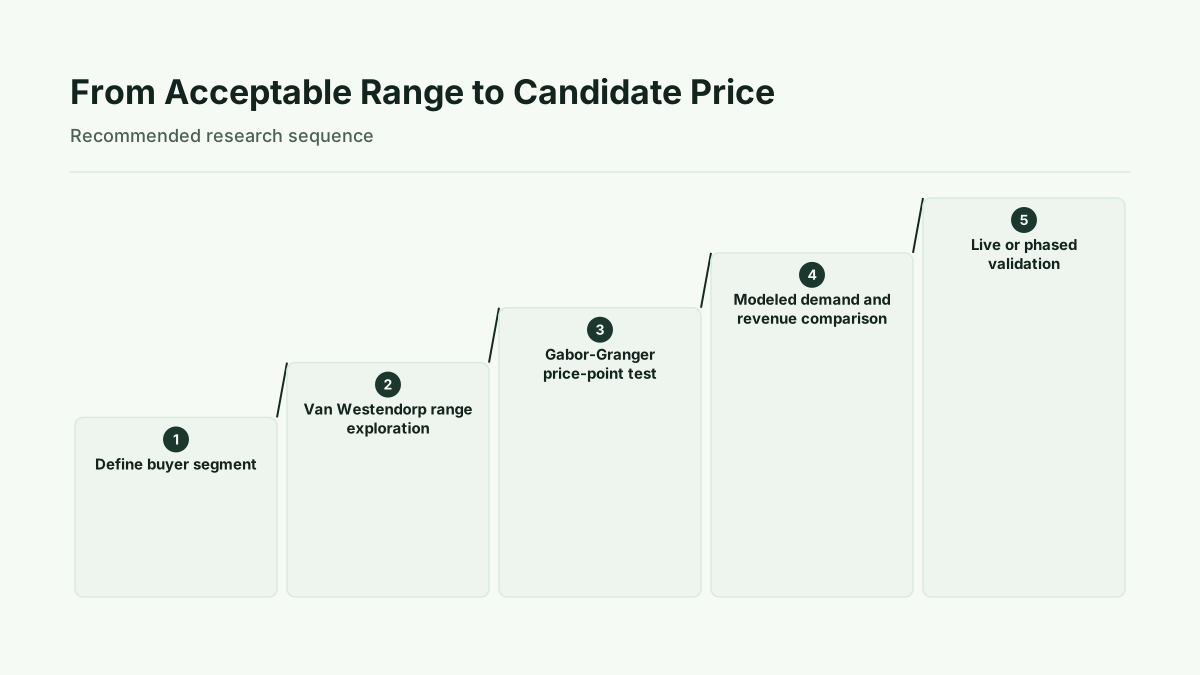
A practical sequence is to define the buyer segment, explore the range with Van Westendorp, test selected price points with Gabor-Granger, and add conjoint only when feature or bundle trade-offs materially affect the choice. This sequence keeps the method connected to the decision rather than adding complexity by default.
For directional study-design planning, cited guidance commonly recommends at least 150 respondents per segment for Van Westendorp stability and at least 100 respondents per segment for Gabor-Granger reliability. Treat those figures as guidance, not as a universal threshold. Audience relevance and study design still determine whether the result is useful.
Compare Self-Serve Research, Consultants, and Enterprise Platforms
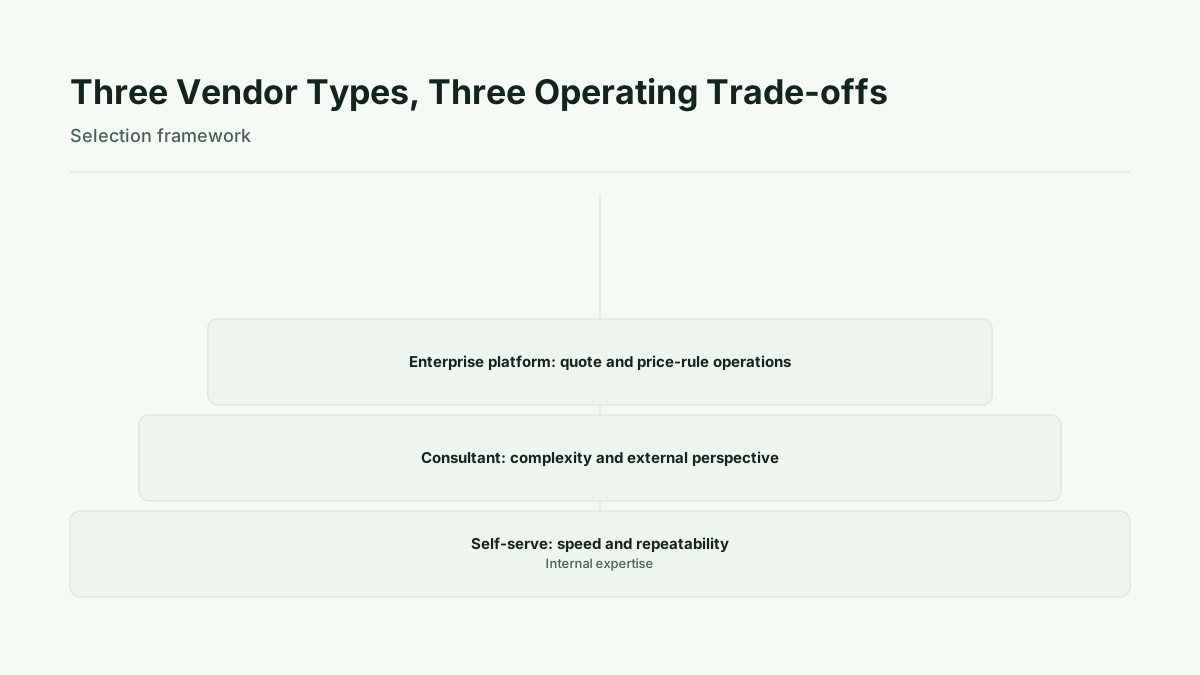
A self-serve research platform is the natural fit when the team values speed, repeatability, and internal ownership. It can suit a founder who expects to revisit pricing as the offer develops and who wants a repeatable workflow rather than a single commissioned project.
A consultant is more appropriate when the research has unusual complexity, when internal expertise is limited, or when external credibility is part of the decision. The trade-off is that the team must evaluate project scope, turnaround, interpretation support, respondent access, and the ability to repeat the work later.
An enterprise pricing platform is relevant when the core requirement is operational enforcement. It should remain in the comparison when the organization needs approved prices and rules carried into quote-to-cash operations. That is a different purpose from asking prospective customers what they may pay.
Compare the three options across six questions: How often will the study be repeated? How complex is the research question? How much internal expertise is available? How quickly is a decision needed? Who will recruit or provide respondents? How much interpretation and external validation is required? These questions expose the operating trade-offs without assuming that one category is best for every job.
Evaluate the Full Workflow and Cost of Ownership
Price should not be the only comparison. Map the full workflow before choosing an approach: respondent sourcing, platform or project fees, analyst time, raw-data export, reproducibility, support, integrations, and the need to refresh the study.
For a founder, repeatability matters because a pricing decision may evolve from range discovery to price-point testing and then to package design. A one-time project may be sufficient for an unusual decision, while a recurring workflow can be more practical when the team expects to run studies again. The comparison should make that difference visible rather than comparing only headline fees.
Also decide what evidence the team needs to retain. A defensible recommendation should preserve the research question, audience definition, method, assumptions, outputs, and decision made from them. That record helps the team understand whether a later change reflects new evidence, a changed offer, or a changed market context.
Where Kinetic Pricing Fits
Kinetic Pricing fits the self-serve customer-facing research category. Its specified workflows and prices are: Price range finder at $149.00, Price point tester at $199.00, Feature value ranker at $279.00, and Package and price builder at $499.00.
Those workflows map directly to the method-to-decision sequence. Price range finder corresponds to range exploration. Price point tester corresponds to testing specified prices. Feature value ranker supports feature trade-off work, while Package and price builder supports package decisions.
This makes Kinetic Pricing a candidate when the founder needs a repeatable research workflow rather than enterprise quote and price-rule enforcement. It does not remove the need to define the audience, interpret the result, or validate the leading price with live behavior. The choice is therefore practical: use a self-serve workflow for recurring customer research, a consultant for unusual complexity or external validation, and enterprise CPQ for downstream operational execution.
Interpretation
Van Westendorp provides a plausible acceptable range, not a guaranteed price. Gabor-Granger turns stated likelihood at tested prices into demand and modeled revenue curves, so a modeled peak is a decision aid rather than observed revenue. Conjoint estimates relative feature and price utilities for package decisions, not a universal willingness-to-pay guarantee.
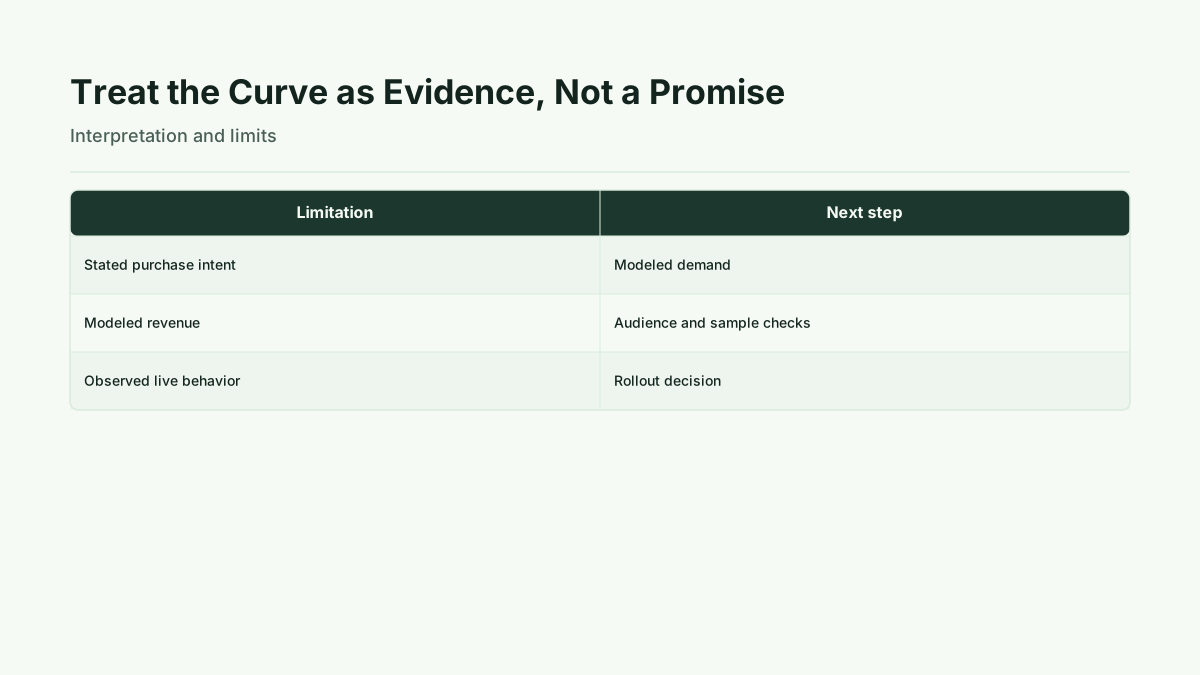
Keep three evidence types separate. Stated purchase intent is what respondents say they might do. Modeled demand and revenue are calculations based on those responses and the assumptions applied to them. Observed behavior comes from a live test or phased rollout. The first two can inform the candidate decision; only the third can show how the offer performs in actual purchasing conditions.
Limits
All survey-based purchase intent is hypothetical. A strong-looking response pattern does not guarantee purchasing behavior, and modeled revenue depends on its assumptions. A leading modeled price should therefore be validated through a live test or phased rollout before a broad rollout.
Sample quality also matters. Respondent-count guidance is directional, and segment definitions should remain relevant to the buyer decision. A result built from the wrong audience cannot be repaired simply by collecting more responses.
Conjoint has a further refresh consideration: its results should be treated as directional after 18 to 24 months and refreshed before major decisions, subject to category change. Faster-moving categories may require a faster refresh. These limits do not make the methods unusable. They define what each method can support and what still requires commercial validation.
Next Step
Define whether the decision concerns an existing offer or package design. Recruit the relevant buyer segment. Run Van Westendorp for range discovery when the range is unknown. Use Gabor-Granger within that range when price-point selection is the goal. Add conjoint only for feature or bundle trade-offs. Then compare modeled candidates with observed behavior in a live test or phased rollout before broad release.
For a founder seeking a Vendavo alternative for customer-facing research, that sequence is the decision rule: choose the research workflow when the uncertainty is what to charge or how to package, and retain enterprise CPQ when the uncertainty has already been resolved and the remaining job is operational enforcement.
Additional context on these methods is available from Gabor‑Granger, conjoint results as directional after 18 to 24 months, Van Westendorp study, 100 or more per segment for Gabor‑Granger, Gabor‑Granger, free pricing research and benchmarks, one-time study or the Pro subscription, self-serve versus consultant breakdown, 150 or more respondents per segment, 10 to 20 percent, Van Westendorp Price Sensitivity Meter explanation (PSU course), Gabor‑Granger method explainer (QuestionPro), Gabor–Granger method (Wikipedia) and Conjoint analysis and pricing guidance (RGM Academy).
Run this method with your users
Start 30-day free trial to run every method with your users, or Buy one study when one decision needs evidence now.
Sources
Pennsylvania State University, Van Westendorp Price Sensitivity Meter explanation
Wikipedia, Gabor-Granger method
QuestionPro, Gabor-Granger method explainer
RGM Academy, Conjoint analysis and pricing guidance
LimeSurvey, Van Westendorp price optimization and conjoint refresh guidance
SightX, Price sensitivity testing guide
East Carolina University, Internet surveys and hypothetical-bias mitigation tools
Kinetic Pricing, Product methods and pricing