A decision guide for early-stage B2B SaaS founders. When a self-serve study answers the question, when a consultant is worth the retainer, and how to sequence both.
A founder with a pricing question has two obvious paths and very little guidance on choosing between them. This is a decision guide, not a sales argument: the two approaches answer different sizes of question, and the useful skill is recognising which one you have.
The short version is that you should choose the smallest credible path to buyer evidence, and escalate only when the work stops being a research question.
The answer
Use self-serve when your buyers can answer the pricing question directly. That covers needing a range, a specific price point, a feature ranking, or a package trade-off. These are bounded questions with a defined output.
Add a consultant when the work crosses into any of these: enterprise contract migration with account-by-account exceptions; regulated billing, procurement, legal or finance constraints; multi-product pricing architecture; or leadership alignment across teams.
There is also a hybrid path, and it is a sequence rather than a compromise. Collect buyer evidence first, then spend expert time on rollout and governance where the evidence shows it is needed.
Why acting early is cheaper
Pricing uncertainty becomes harder to unwind as customers accumulate. The mechanism is simple and operational.
Guess. A founder sets a price from instinct or from competitor pages.
Accumulate. New customers anchor on the untested number and package. Every new contract adds another relationship to a future price change.
Migrate. A later correction now needs communication, exceptions, and retention risk management.
The early-stage advantage is not perfect certainty. It is a cheaper correction window, and that window closes gradually without anyone noticing.
Cash at risk
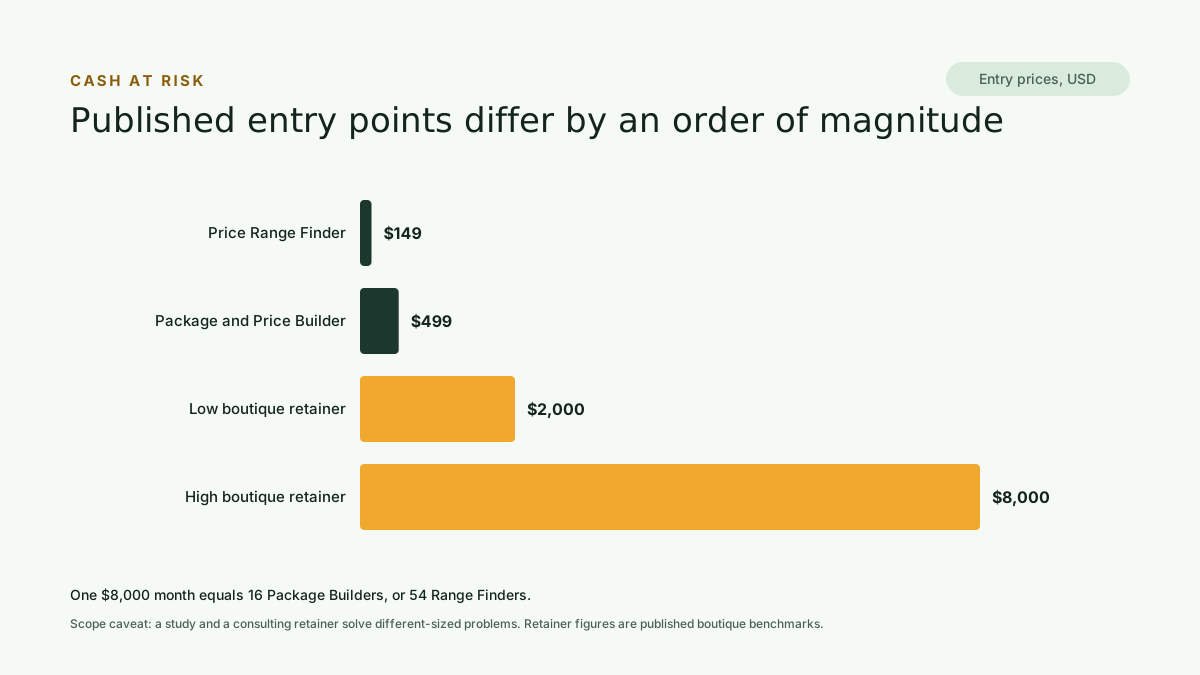
Published entry points differ by at least an order of magnitude.
Kinetic's studies run from $149 to $499. Published boutique pricing retainers commonly start between $2,000 and $8,000 per month. The low boutique retainer begins roughly four times above the most expensive Kinetic study.
Put differently: one $8,000 month equals sixteen Package and Price Builders, or fifty-four Price Range Finders.
The scope caveat matters and is not a formality. A study and a consulting retainer solve different-sized problems. This compares published cash entry points, not equivalent deliverables.
Keep reading — it’s free.
Enter your email to unlock the remaining 7 sections of this report and download the full files. We’ll send the download links to your inbox too.
One email with your links — no drip sequence. Kinetic Pro members and trialists get instant access.
Time to answer
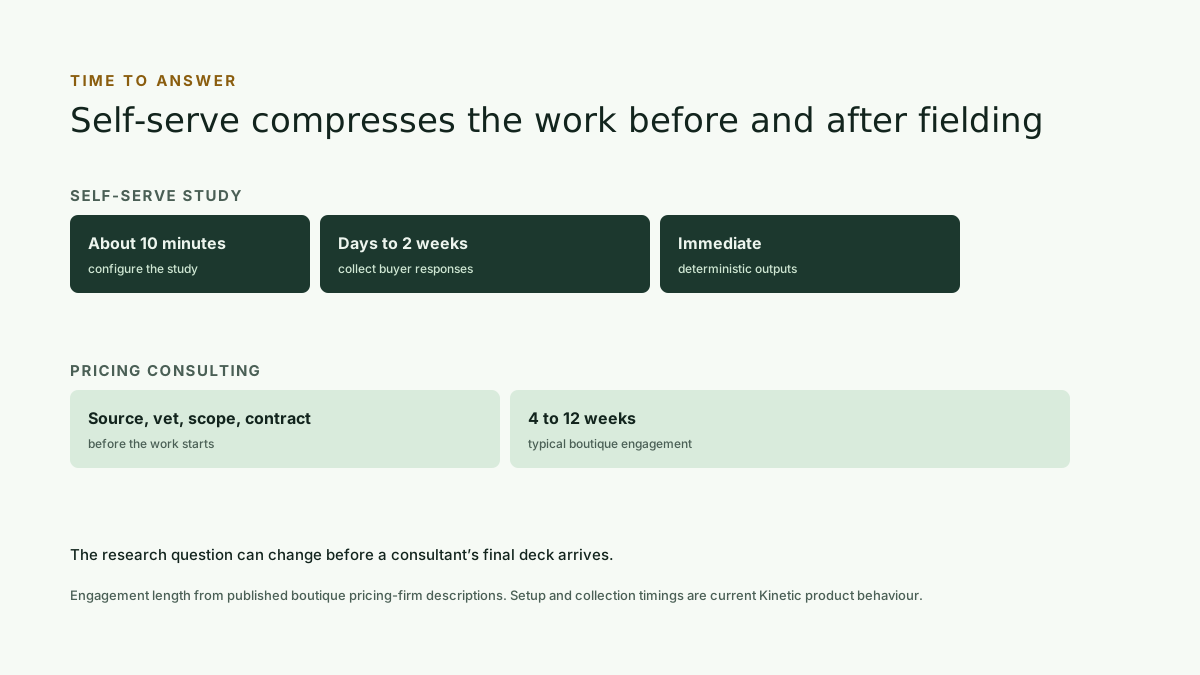
Self-serve compresses the work before and after fielding, not just the fielding itself.
A self-serve study takes roughly ten minutes to configure, days to two weeks to collect responses, and produces deterministic output immediately once the threshold is met.
A consulting engagement adds a phase most comparisons omit: sourcing, vetting, scoping, contracting and scheduling all happen before any work starts. Published descriptions of boutique pricing engagements put the engagement itself at four to twelve weeks.
The practical consequence is that the research question can change before a consultant's final deck arrives. Faster cycles let a founder test, learn, and revisit pricing as the product changes.
What each path actually measures
The strongest approach matches the evidence source to the decision.
Self-serve buyer research measures price perceptions and purchase responses from your own audience, and feature or package trade-offs using a repeatable method. It is best for a bounded answer you can rerun after the product or the segment changes.
Consultant judgement adds competitive context, economic modelling, and category experience, plus facilitation across leadership, finance, sales and customer teams. It is best for a system-wide change that needs judgement, coordination and implementation support.
Neither is universally better. Use buyer data as the baseline, and add specialist context when governance or rollout demands it.
Four decisions, four methods
Choose the method by the decision you need to make.
Method
Price
The question it answers
Technique
Price Range Finder
$149
What range will buyers accept?
Van Westendorp
Price Point Tester
$199
Which candidate price produces the best demand and revenue trade-off?
Gabor-Granger
Feature Value Ranker
$279
Which features or benefits drive preference?
MaxDiff
Package and Price Builder
$499
How should features and prices combine into tiers?
Choice-based conjoint
Each engine computes the numbers deterministically. The written explanation is generated afterwards and checked against the engine output, so it can describe a result but cannot invent one.
How the method works
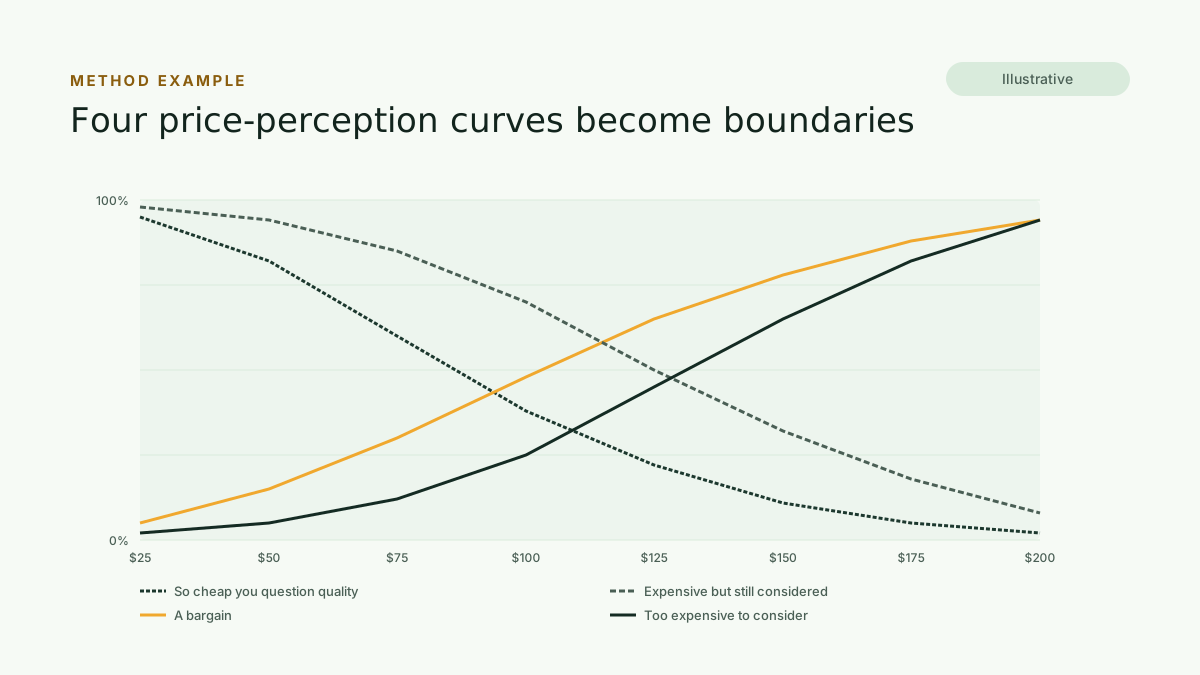
Four prompts, four curves. The engine calculates the intersections; the narrative explains them.
Van Westendorp asks four price-perception questions: at what price the product becomes so cheap you would question the quality, a bargain, expensive but still worth considering, and too expensive to consider at all.
Each answer becomes a cumulative curve. Where those curves cross defines the boundaries of a credible price range.
The curves shown here are illustrative and exist to explain the mechanics. They are not a customer result.
Confidence and sample size
Small samples guide direction. Confidence grows with valid responses, and Kinetic labels the state of the evidence rather than hiding it.
Under 15 valid responses: directional only. Inspect patterns, keep claims provisional, and the written narrative stays gated.
15 to 29: caution. Use the result to choose a direction, then keep collecting.
30 or more: full confidence. Use the complete analysis at the product's strongest confidence state.
Valid responses matter more than a raw response count, and these are Kinetic's interface thresholds rather than a universal statistical rule. The right sample depends on the method, the heterogeneity of your audience, and how much the decision costs to get wrong.
Decision matrix
Situation
Route
Reason
A buyer pricing question
Self-serve
Test a range, an exact price, feature value, or a package trade-off.
Consulting scope discovery
Hybrid
Collect buyer evidence first, then define the expert work precisely.
Contract migration or regulation
Consultant
Coordinate finance, legal, procurement and change management.
Multi-product pricing architecture
Consultant
Align product, sales, finance, systems and leadership.
Hybrid is a sequence: measure first, then buy expertise for rollout and governance.
The recommendation is to start with the smallest credible study. Choose the pricing question, collect evidence from your buyers, and bring in a consultant when rollout, regulation or alignment enters scope.
Sources
Boutique retainer benchmarks and engagement durations are drawn from published descriptions by pricing consultancies. Kinetic prices and confidence thresholds are current product values. Van Westendorp curves shown are illustrative.
Four public pricing pages scored across eight dimensions. Dedicated monetization teams run these pages, and the average still leaves 23 points unclaimed.
68 AI pricing pages scored across eight dimensions. Billing framing is the dimension that separates a good page from a bad one, and half the category skips it entirely.