Half the category never tells you how billing works (locked section)
The companies selling AI have the worst pricing pages in AI (locked section)
One page in sixty-eight uses an anchor (locked section)
Credits are the new default unit (locked section)
Steal the craft, skip the privileges (locked section)
Sources (locked section)
We scored 68 AI and AI-adjacent pricing pages across eight dimensions of pricing-page craft. The mean was 72 out of 100.
One dimension carried almost all of the difference between a good page and a bad one, and it is the one the category most often skips. Billing framing averaged 5.6, and 35 of the 68 pages scored 4 or below. Between the top fifteen pages and the bottom fourteen it showed a 4.8 point gap, wider than any other dimension.
The pattern underneath is consistent enough to state plainly. AI companies are good at explaining what a unit is. They are bad at explaining what happens when you buy one.
What we measured
Every page went through the same scorer, which rates it as a selling artifact rather than judging the price itself. A company can be priced well and still score badly here, and several are.
The eight dimensions are value-metric clarity, tier fencing, price anchoring, plan naming, billing framing, trial and freemium logic, enterprise path, and price formatting. Each is scored 0 to 10 and rolled into a page craft score out of 100.
Scores reflect each page as it stood on 5 August 2026. Pricing pages change.
The scoreboard
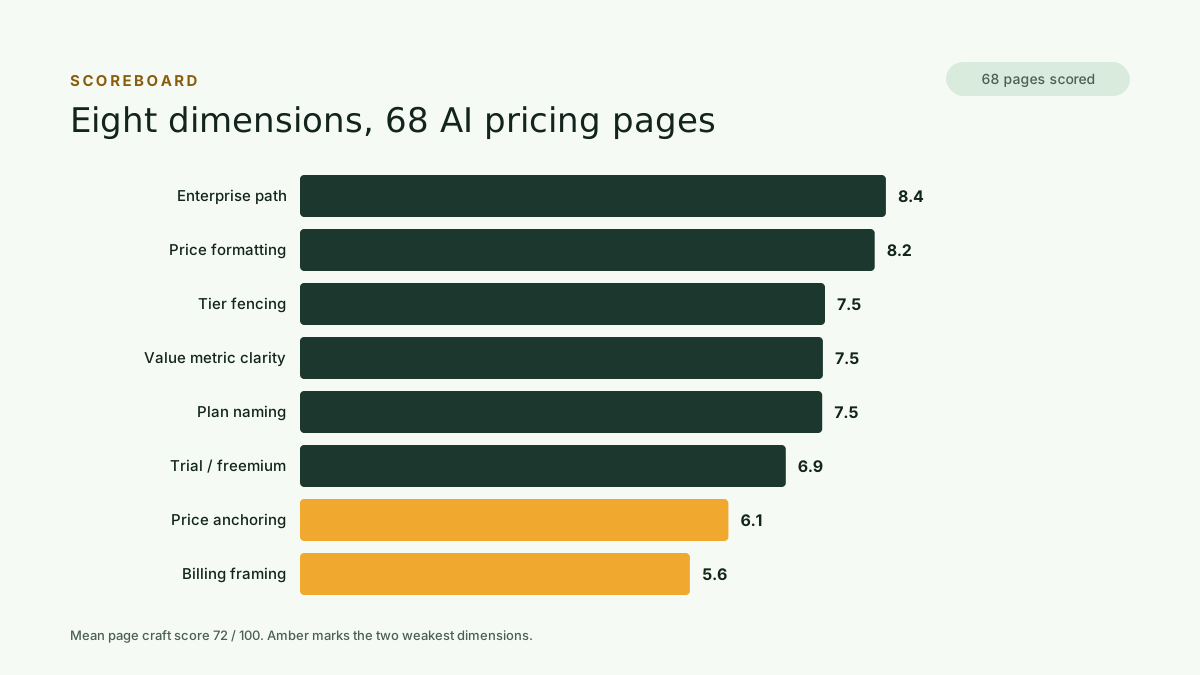
Two dimensions carry the category. Two are dragging it down.
Two things are solved. Enterprise path averages 8.37, with 49 of 68 pages scoring 9 or above on routing a large buyer to a conversation. Price formatting averages 8.21. Whatever else the category gets wrong, it knows how to write a number and how to find a sales team.
Two things are not. Price anchoring averages 6.12 and billing framing averages 5.57, and they fail in different shapes. Billing framing is bimodal: 35 pages at 4 or below, 20 at 9 or above, only 13 anywhere in the middle. Anchoring has almost no failures at all and almost no successes either. Three pages score 4 or below and exactly one scores above 8.
That distinction matters. Billing framing is a gap that some companies have closed. Anchoring is ground nobody has taken.
Every company scored
Company
Score
Company
Score
Descript
89
Anyword
75
Fireflies.ai
86
Framer
75
Zapier
86
HeyGen
75
Runway
86
LangChain (LangSmith)
75
Anthropic (Claude)
84
Mistral AI
75
Replit
84
Deepgram
75
Jasper
83
Weights & Biases
74
Synthesia
83
Weaviate
74
Bolt.new
83
GitHub Copilot
74
Intercom
83
Zed
74
n8n
81
Windsurf
74
Otter.ai
81
Speechmatics
73
ElevenLabs
81
Suno
73
Durable
80
AssemblyAI
71
Braintrust
80
Grammarly
71
Krisp
79
Augment Code
71
Fathom
79
Read AI
69
Pinecone
79
Vercel v0
69
Elicit
79
Lindy
69
Photoroom
78
Copy.ai
68
Beautiful.ai
78
Cursor
68
Chroma
78
Sunsama
68
Modal
78
Granola
68
Qodo
78
Gumloop
68
Notion
78
Sudowrite
68
Writesonic
78
Baseten
66
Mem
66
Captions
64
Wordtune
66
Cohere
64
You.com
65
Luma AI
63
Replicate
61
Together AI
61
Opus Clip
60
Fireworks AI
60
RunPod
59
Rytr
59
Regie.ai
59
Sourcegraph (Cody)
54
DeepInfra
51
OpenRouter
26
Keep reading — it’s free.
Enter your email to unlock the remaining 6 sections of this report and download the full files. We’ll send the download links to your inbox too.
One email with your links — no drip sequence. Kinetic Pro members and trialists get instant access.
Half the category never tells you how billing works
Billing framing does not fail gently. Companies either handle it properly or omit it entirely, and the failure is the same one every time: a single cadence on the page, no toggle, no annual saving stated.
GitHub Copilot shows only a monthly cadence at $10 USD per user / month, omitting annual billing where software buyers expect both.
Grammarly shows a single cadence where buyers expect two.
Weaviate offers Pay-as-you-go, monthly, no commitment. on its mid tier with no annual option and no toggle.
Sourcegraph states Starting at $16K without labelling whether that is annual or monthly.
The companies that got it right did something unremarkable and specific. Otter.ai writes Monthly Annual save 51%. Replit writes Save 20% $25 $20 per month billed annually. Jasper writes Monthly Yearly Save ~20%. Krisp writes Monthly Annually Save 50%.
Steal this: show both cadences with the saving stated as a percentage. It is an afternoon of work, and it is the single change most likely to move a page's score.
The companies selling AI have the worst pricing pages in AI
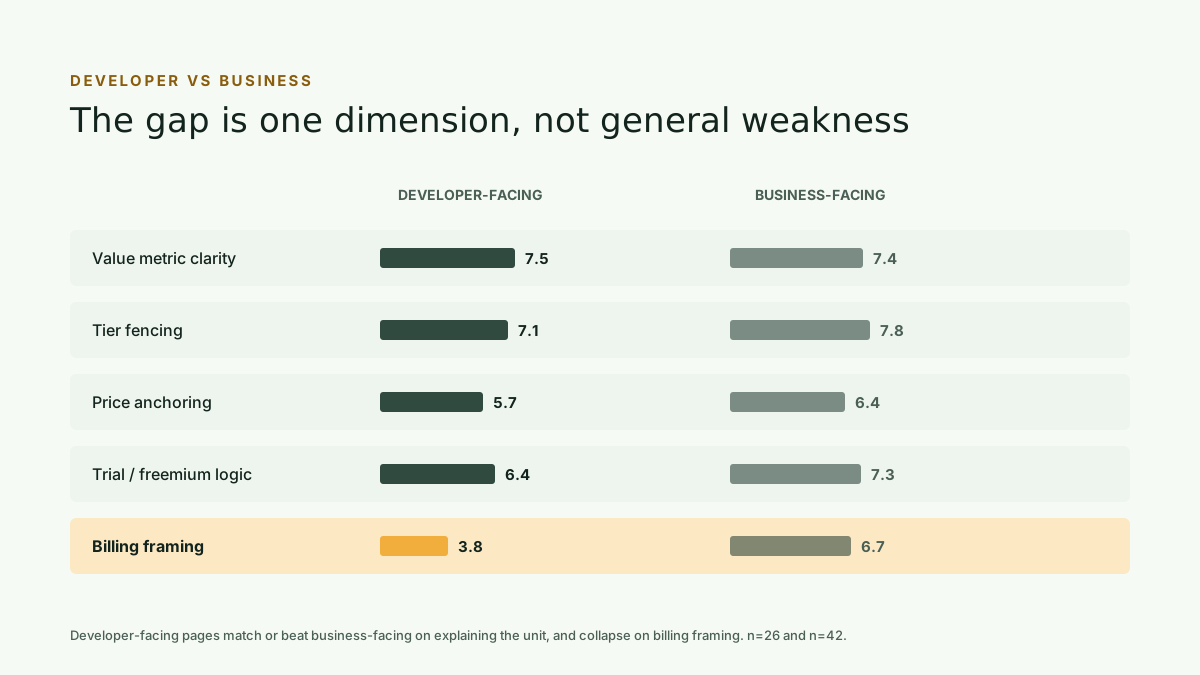
The gap is one dimension, not a general weakness.
Developer-facing pages, meaning LLM APIs, inference platforms, vector databases and coding tools, average 68.8. Business-facing AI products average 74.3.
The interesting part is where that gap does not come from. On value-metric clarity, developer-facing pages score 7.5 against 7.4 — they are marginally better at explaining what the unit is. Per million tokens. Per GPU hour. Per second of compute. The clarity is there.
The gap is almost entirely billing framing, at 3.8 against 6.7, with trial and freemium logic second at 6.4 against 7.3.
Five developer platforms score 2 out of 10 on trial logic, with no free credit, trial period or freemium tier stated anywhere on the page: Replicate, OpenRouter, RunPod, Together AI and DeepInfra. These are products whose entire adoption motion is a developer trying something in an afternoon.
They tell you the price of the thing and nothing about the transaction.
One page in sixty-eight uses an anchor
Price anchoring averages 6.12, and the distribution is the finding. Only three pages score 4 or below, so this is not widespread failure. It is widespread adequacy. Almost everyone does the same acceptable thing: mark one plan most popular, and stop.
Exactly one page scores above 8.
Lindy places a decoy at the top of its ladder: Human assistant The classic option. $8,000 / month, sitting beside its AI tiers. Every price below it reads as a saving rather than a cost. The comparison is doing the selling.
Steal this: put the thing your product replaces on the page, with its real cost attached. It is free to add, and in a sample of 68 companies, one had thought of it.
Credits are the new default unit
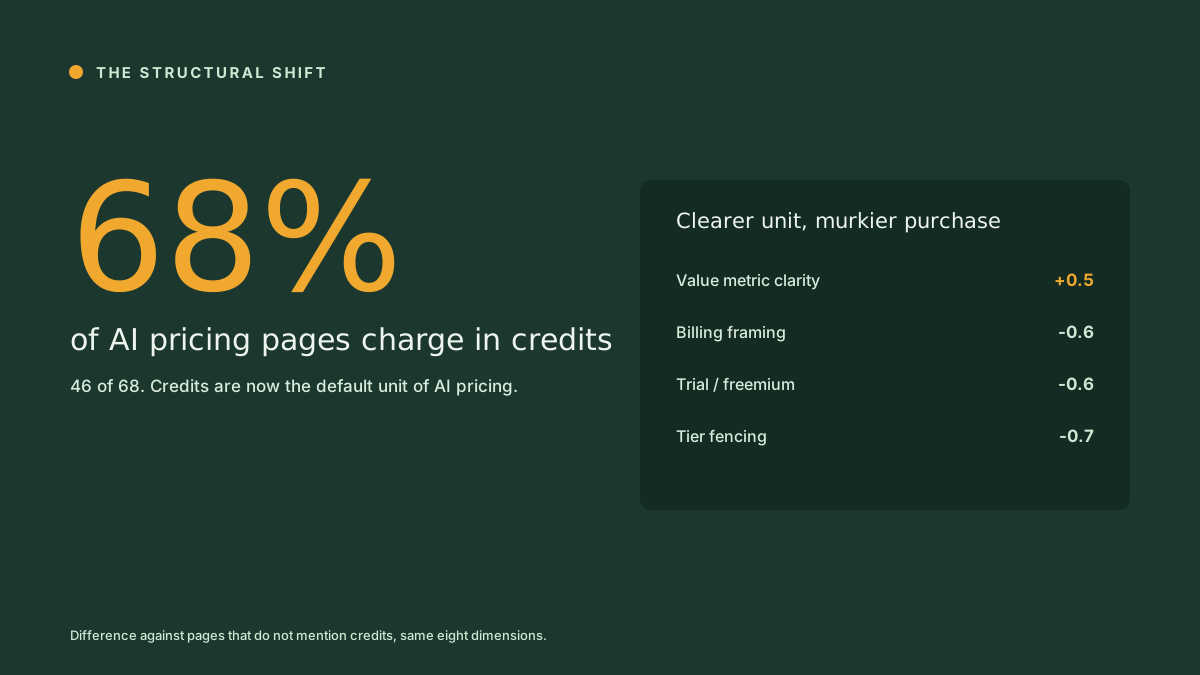
Credit pricing makes the unit clearer and the purchase murkier.
46 of 68 pages, or 68%, price in credits. Credits have quietly become the default unit of AI pricing, and the trade they carry is measurable.
Against pages that do not mention credits, credit-priced pages score +0.5 on value-metric clarity and -0.6 on billing framing, -0.6 on trial and freemium logic, and -0.7 on tier fencing.
Credits make the unit clearer and the purchase murkier. A buyer can see what a credit buys and cannot see what a month costs, what happens when the credits run out, or how the tiers differ once you strip the credit allowance away.
Steal the craft, skip the privileges
Steal: both billing cadences on the page with the saving as a percentage. An anchor, meaning the thing you replace with its real cost. A stated free allowance in real units rather than the words free trial alone. An explicit statement of what happens when someone hits the limit, which almost nobody writes.
Skip: hiding every price behind contact sales, which large brands can afford and you cannot. Credit units nobody can convert into a number of things they will actually receive. A pricing page written for the engineer who integrates the product rather than the person who approves the spend. Copying a competitor's structure, since half of them are scoring 60 or below too.
Sources
Scores were produced by the Kinetic teardown engine on 5 August 2026. Every figure in this report traces to that run. Company names and quoted page text are reproduced as they appeared on the run date.
Four public pricing pages scored across eight dimensions. Dedicated monetization teams run these pages, and the average still leaves 23 points unclaimed.
When does a self-serve pricing study answer the question, and when do you actually need a consultant? A decision guide with published cash and time comparisons.