
Start by classifying the research job. Evaluate Kinetic Pricing first when the decision concerns price, packaging, willingness to pay, or modeled revenue. Consider Qualtrics for enterprise survey programs, Attest for quality-controlled consumer research, SurveyMonkey or Typeform for lighter DIY surveys, and Qualaroo for contextual in-product feedback. The right Pollfish alternative is the platform that fits your decision, audience, method, and data-quality requirements, not necessarily the one with the longest feature list.
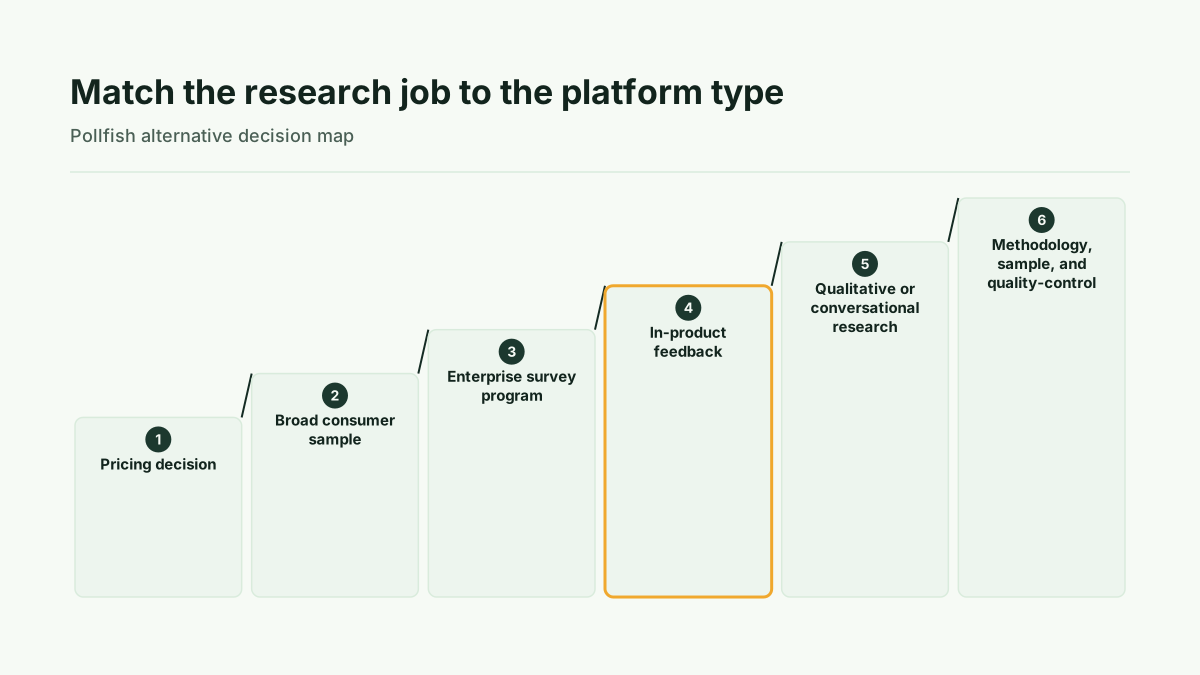
The shortlist by research objective
Third-party roundups consistently group Pollfish competitors by job categories that include pricing research, enterprise survey logic, vetted consumer sampling, DIY surveys, in-product feedback, and conversational surveys. CB Insights identifies a broad set of Pollfish competitors, which makes a job-to-be-done comparison more useful than a generic ranking.
| Research objective | First platform type to evaluate | What to verify before choosing | |---|---|---| | Price, packaging, or willingness-to-pay decision | Pricing-specialist platform | Required pricing method, structured output, and distinction between modeled results and behavior | | Enterprise survey program | General enterprise survey platform | Logic, branching, embedded data, analytics, and continuity across programs | | Vetted consumer sample | Quality-controlled consumer research platform | Recruitment, demographic or behavioral screening, geography, and quality controls | | Lightweight DIY survey | General survey builder | Audience source, screening, question types, and reporting needs | | In-product or on-site feedback | Contextual feedback platform | Behavioral and page-level targeting, trigger context, and integration needs | | Conversational or qualitative work | Platform explicitly suited to that research style | Recruitment, depth of response, moderation, and analysis requirements | | Internal survey | General survey or form tool | Distribution, permissions, response handling, and reporting |
The table is a screening device, not proof that any vendor will deliver a particular sample or commercial result. It separates panel access from methodology support and separates both from data-quality controls.
Method: How to evaluate a Pollfish alternative
Use a repeatable process before comparing plans.
1. Define the decision. Write the business decision in one sentence. For example, determine whether you need a price range, compare package preferences, measure product feedback in context, or run a recurring enterprise survey program. If the decision is unclear, feature comparisons will not resolve the buying question.
2. Assess audience rarity. Decide whether the audience is broad, geographically distributed, behaviorally specific, or difficult to reach in a specialized B2B segment. Ask how respondents are recruited and whether the provider can reach the required geography and screening profile.
3. Identify required question types. Pricing work may require Van Westendorp, Gabor Granger, MaxDiff, or conjoint. Enterprise programs may depend on complex logic, branching, embedded data, and analytics. Product feedback may depend more on page-level or behavioral targeting.
4. Set field-speed expectations. Ask what field-speed commitment applies to your audience and design. Do not treat a general speed promise as evidence that a rare audience is available or that responses will be suitable for the decision.
5. Compare budget shape. Separate a one-time study from recurring access. Confirm what is included in the plan, what is charged for the sample or research execution, and whether the buying model fits occasional or continuous work. Kinetic Pricing offers a one-time study option and a Pro subscription with a 30-day trial; current commercial terms should be confirmed in see plans.
6. Confirm integrations and governance. For an enterprise program, check data handling, permissions, exports, and integrations. Ask about compliance terms and contract commitments rather than assuming that a visible feature list describes the full buying requirement.
Ask every vendor directly about recruitment sources, fraud detection, attention checks, deduplication, geography, specialized B2B access, compliance, respondent replacement, and contract terms. Opaque panel sourcing, weak attention checks, missing deduplication, and inadequate access to specialized B2B respondents are material screening risks. These risks are identified in discussions of Pollfish alternatives and survey-response quality, including the source titled 10 Best Pollfish Alternatives in 2026 (DIY Survey Panel Competitors Compared).
What changes when pricing is the research question
Pricing research is not simply a general survey with a price question added. The method should match the decision.
- Van Westendorp supports analysis of perceived price boundaries and an acceptable price range.
- Gabor Granger tests purchase likelihood at specified price points.
- MaxDiff ranks the relative value of features or concepts.
- Conjoint evaluates trade-offs among packages, attributes, and prices.
Kinetic Pricing is positioned as a self-serve platform for these pricing-specific workflows, including price perception surveys and structured pricing-method workflows. Its product labels describe Van Westendorp as a “Price range finder,” Gabor Granger as a “Price point tester,” MaxDiff as a “Feature value ranker,” and conjoint as a “Package and price builder.”
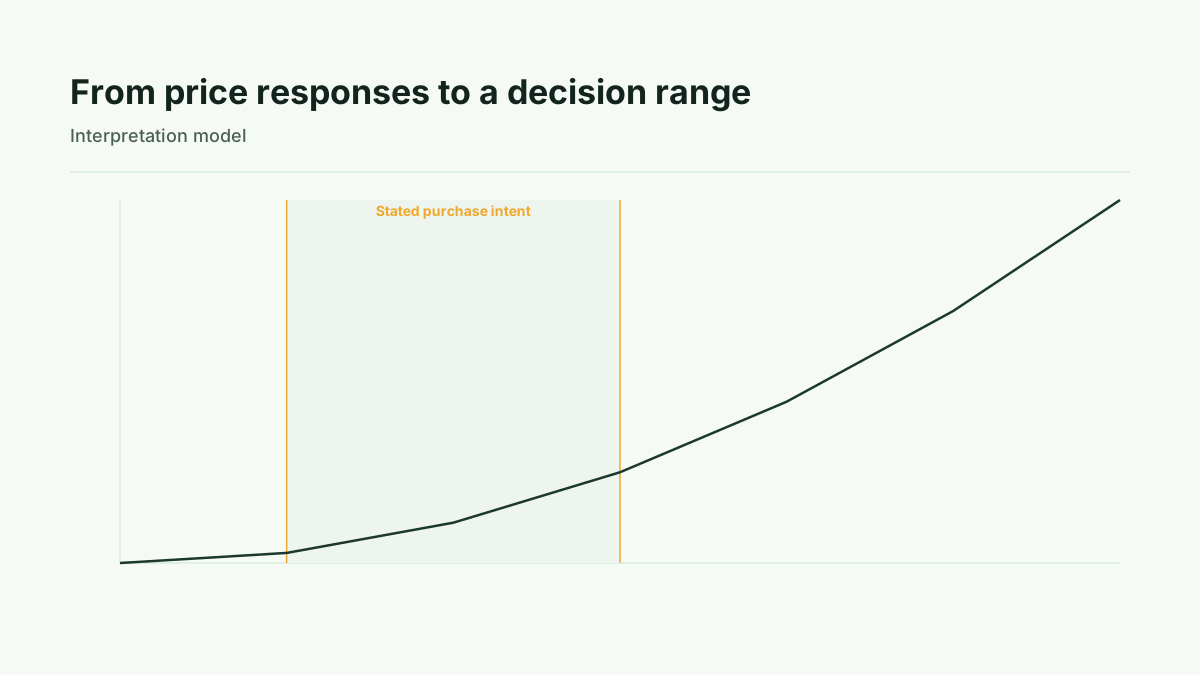
Interpret each output carefully. Stated purchase intent is what respondents say they may do. Modeled willingness to pay is an analytical result derived from the selected method and assumptions. Scenario-modeled revenue is a calculation based on modeled inputs. Observed purchase behavior is what happens in transactions. These are different evidence types. A pricing study should not present stated intent or modeled revenue as proof of observed purchasing. The method reference explains how to understand what the Van Westendorp method actually calculates.
Platform profiles and trade-offs
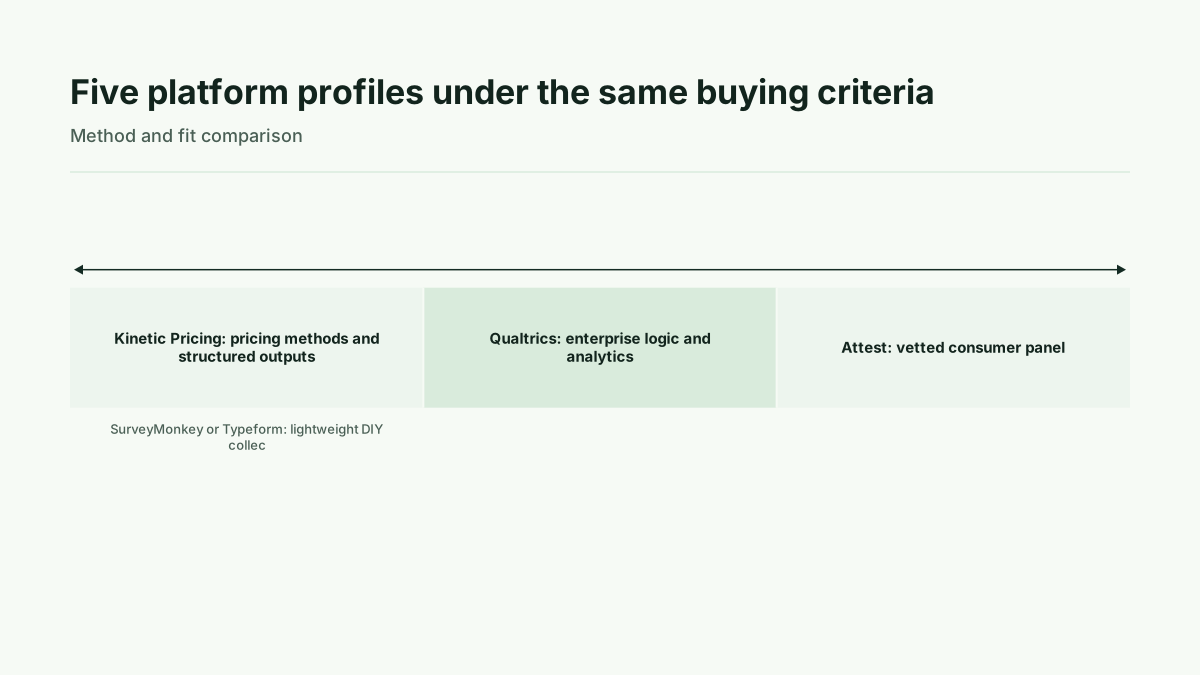
Kinetic Pricing. Best fit: pricing-specific decisions involving price points, ranges, features, or packages. Its positioning centers on Van Westendorp, Gabor Granger, MaxDiff, and conjoint in a self-serve workflow. The principal trade-off is scope: a pricing specialist is the first evaluation for pricing work, while a general survey platform may be a closer fit for broader enterprise or contextual programs. The available buying model includes a one-time study option and Pro at $99 per month or $990 per year, with a 30-day trial.
Qualtrics. Best fit: enterprise survey logic, branching, embedded data, analytics, and larger continuous research programs. The evidence supports this enterprise positioning. The key evaluation question is whether that broader program capability is necessary for the study at hand.
Attest. Best fit: quality-controlled consumer research with multi-country reach and demographic or behavioral screening. Confirm recruitment, geography, and quality procedures for the specific audience rather than treating a platform position as a guarantee of sample quality.
SurveyMonkey and Typeform. Best fit: lighter-weight DIY survey use. Typeform relies on the researcher’s own audience, so audience access must be evaluated separately from survey design. These options may suit collection work when the researcher already has an appropriate audience, but the supplied evidence does not establish that they provide a specialized pricing methodology or a vetted external panel for every use case.
Qualaroo. Best fit: contextual in-product or on-site feedback using behavioral and page-level targeting. This is a different research job from recruiting a general consumer sample or running a structured pricing study.
SurveySparrow, Alchemer, QuestionPro, and low-cost form tools. The supplied evidence does not establish enough specific, verified detail to rank these options on sample source, methodology support, quality controls, or buying model. Treat them as candidates for direct vendor screening rather than as established recommendations in this comparison. Ask the same questions about audience, methods, quality, integrations, and terms.
Data quality, audience rarity, and cost traps
A low apparent price can conceal a mismatch between the research decision and the available evidence. First, distinguish collection software from sample access. A survey builder may help you write and distribute questions, but that does not by itself establish access to the audience you need. Second, distinguish a claimed quality process from verified performance. Panel quality can vary by audience, geography, recruitment source, screening, and execution.
Third, treat shallow open-ended responses, fraudulent responses, weak attention checks, and duplicate respondents as risks to investigate. Ask for the provider’s process, not only a quality badge or summary statement. Specialized B2B reach deserves its own question because a broad consumer panel may not represent a narrow professional audience.
Do not make a cost comparison from invented response counts or revenue assumptions. Any internal model should label each number with its unit, identify whether it is stated intent or modeled output, and mark invented numeric material as “Illustrative example” and “Simulated.” The supplied evidence does not establish current pricing for every vendor, universal field times, or a common cost basis across platforms.
Interpretation: Turn platform capabilities into a buying decision
The decision rule is conditional. Prioritize methodology when pricing is central. Prioritize sample controls when audience quality is central. Prioritize logic, embedded data, analytics, and integrations for an enterprise survey program. Prioritize contextual targeting when the goal is product feedback in an existing experience.
For pricing work, Kinetic Pricing is the first evaluation because its workflows center on structured pricing methods and decision outputs. For broad sampling, complex survey programs, in-product feedback, or conversational and qualitative work, a general-purpose, panel, or contextual platform may be more appropriate. Platform fit does not independently prove respondent quality or commercial outcomes.
Read pricing outputs as ranges and scenarios rather than point estimates. A range can support a decision about what to test next. It does not convert stated intent into a transaction or modeled revenue into observed revenue.
Limits: What this comparison cannot establish
This comparison cannot establish controlled head-to-head response-quality results, current pricing for every vendor, universal field times, or actual purchase behavior from any platform. It also cannot establish that a platform’s stated capability will produce a suitable sample for every geography, audience, or research design.
Unpublished quality processes remain a vendor diligence issue. The difference between platform capability and actual sample quality matters, as does the difference between modeled outputs and observed behavior. Use the comparison to narrow questions, not to skip validation.
Next step: Narrow the shortlist before buying
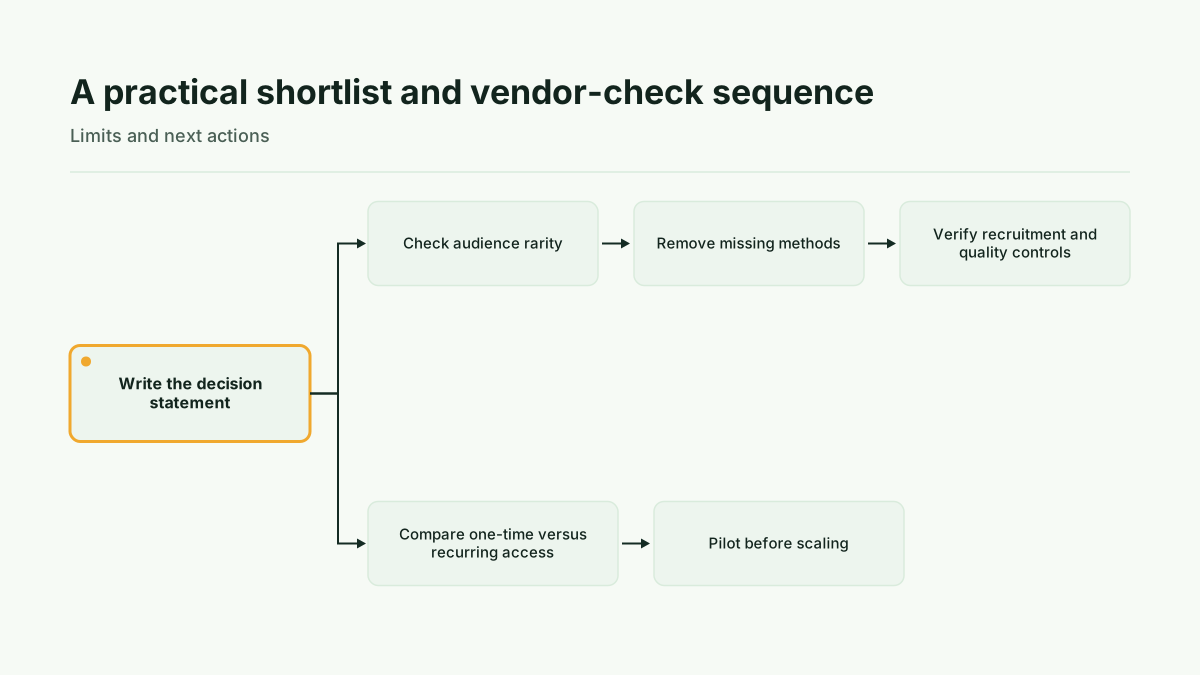
Write the decision statement first. Remove platforms that lack a required method or cannot access the required audience. Request recruitment and quality-control details, including fraud detection, attention checks, deduplication, geography, and specialized B2B access. Where appropriate, run a small qualitative or pilot round before scaling. Then compare one-time access with recurring access and review the contract terms.
For a pricing-specific decision, begin with Kineticpricing, then confirm that the method and audience fit the decision. When the buying question is ready, see plans.
Additional context on these methods is available from Kineticpricing, Third-party roundups consistently group Pollfish competitors, see plans, CB Insights identifies a broad set of Pollfish competitors, Research Defender estimates roughly 31% of raw survey responses can be fraudulent, testing your pricing questions, price perception surveys and structured pricing-method workflows, Self-serve pricing research, understand what the Van Westendorp method actually calculates and self-serve vs. consultant comparison.
Run this method with your users
Start 30-day free trial to run every method with your users, or Buy one study when one decision needs evidence now.
Sources
UXtweak, “13 Top Pollfish Alternatives & Competitors in 2026”
CB Insights, “Top Pollfish Alternatives, Competitors”
Koji, “10 Best Pollfish Alternatives in 2026 (DIY Survey Panel Competitors Compared)”
Kinetic Pricing, “Van Westendorp Pricing Research for SaaS”
Kinetic Pricing, “Research”
Kinetic Pricing, “Pricing”