
A single price creates a false sense of precision when you have not established the market boundaries around it.
Start with a range. Find the point where a low price begins to weaken trust and the point where a high price leaves consideration. The space between those boundaries gives you a credible field for the next pricing decision. The method behind the range is Van Westendorp, and our Van Westendorp guide covers the technique itself in depth.
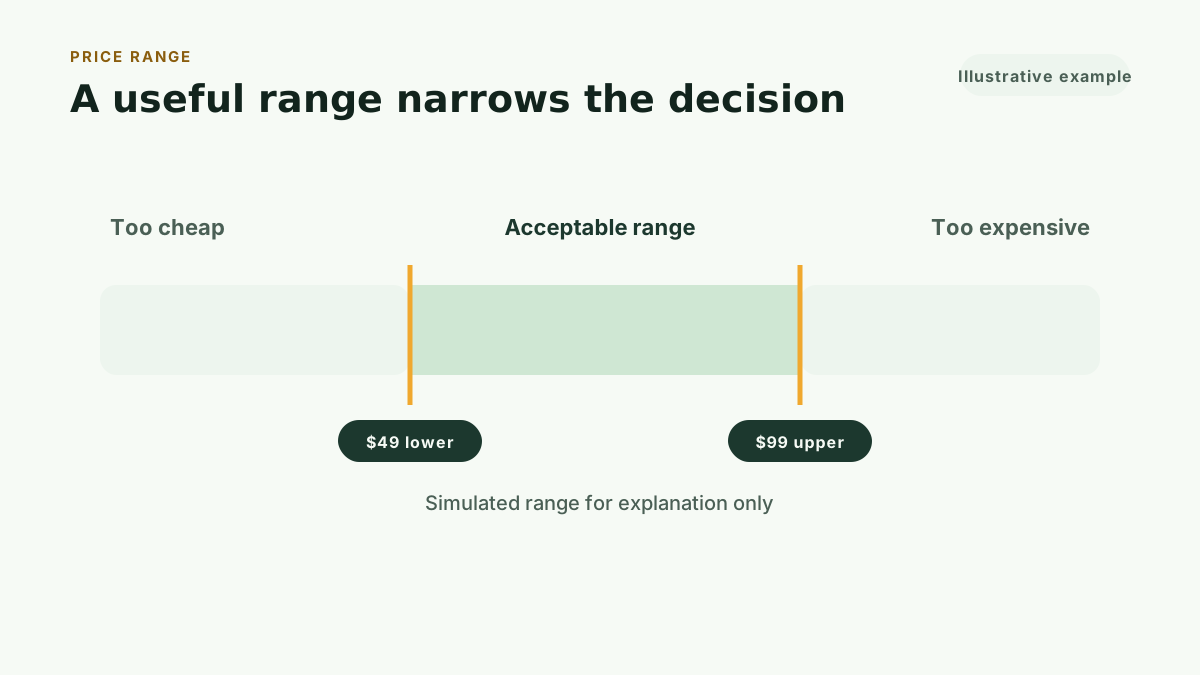
A useful range has two boundaries
The lower boundary answers a quality and credibility question. A price below that point can make customers wonder whether the product lacks the capability, service, or reliability they expect.
The upper boundary answers a consideration question. A price above that point pushes the offer outside what the audience will consider for the described product.
The acceptable range sits between those boundaries. It does not promise equal demand at every price inside it. It gives you a defensible place to select proposed prices for the next test.
Qualtrics describes the Van Westendorp Price Sensitivity Meter as a method for constructing an acceptable range from four customer questions. Conjointly defines the lower and upper intersections as the limits of a psychologically acceptable range. If you are still choosing between methods, start with our overview of how to test SaaS pricing with real customers.
Define the product before asking about price
Customers need enough context to judge the offer. Give each respondent the same description of:
- The product and core outcome
- The intended customer
- The billing period and currency
- The included usage, seats, or limits
- The level of support or service
Keep the description short enough to read. Include the details that change how a buyer would value the product.
A customer who imagines a self-serve tool will answer from a different frame than a customer who imagines onboarding, support, and team access. The study must hold that frame steady.
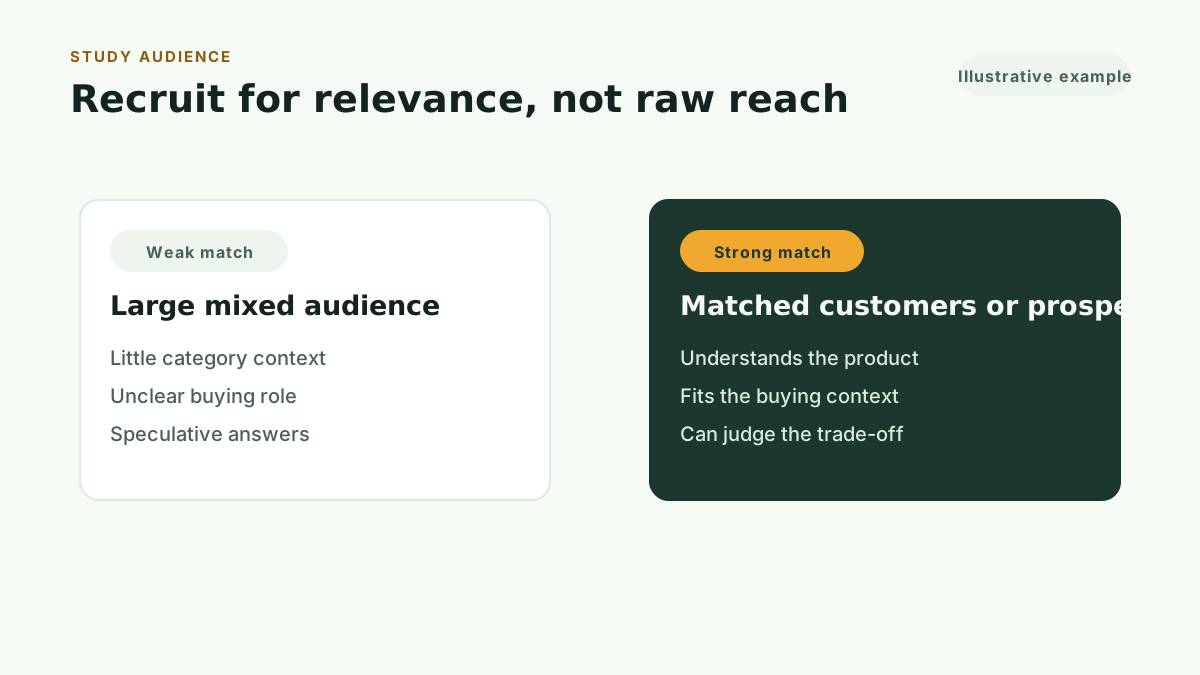
Recruit people who can judge the offer
Current customers make strong participants for repricing work because they know the product and the problem. Qualified prospects can help with a new offer when they understand the category and match the expected buyer.
Screen for buying context rather than broad interest in startups or software. A founder with no need for the product can still give you a number. That number has weak value for the pricing decision.
Ask four recruiting questions:
- Does this person face the problem?
- Does this person understand the type of product?
- Does this person influence or make the purchase?
- Does this person match the customer you want to serve?
Ask for four price perceptions
Van Westendorp gives each respondent four prompts:
- At what price would the product feel so cheap that you would question its quality?
- At what price would the product feel like a bargain?
- At what price would the product begin to feel expensive, while staying worth consideration?
- At what price would the product feel too expensive to consider?
These questions create four thresholds for each respondent. The analysis aggregates those thresholds into cumulative curves and finds their intersections.
The method asks customers to judge price perception. It does not ask them to forecast a purchase count or select one final price. Our guide to Van Westendorp pricing research for SaaS founders walks through the four cumulative curves and each intersection point in detail, and our guide to pricing survey questions covers the exact wording and the mistakes that skew answers.
Check the answer order
Each respondent’s four numbers should follow a sensible order:
Too cheap < bargain < expensive < too expensive
An answer set that breaks this order may signal confusion, a typo, or weak engagement. Review the study instructions and validation rules before launch. Do not repair incoherent answers by guessing what the respondent meant.
Clear currency and billing-period labels prevent avoidable errors. “$99” can mean per month, per year, per user, or per company.
Read the acceptable range before the named points
The main Van Westendorp chart contains four intersections:
- Point of marginal cheapness, or PMC
- Point of marginal expensiveness, or PME
- Optimal price point, or OPP
- Indifference price point, or IPP
PMC and PME define the lower and upper boundaries of the acceptable range. OPP balances the two extreme perceptions, too cheap and too expensive. IPP balances bargain and expensive perceptions.
The word “optimal” can mislead. OPP does not calculate the price that maximizes your profit, revenue, conversion, or customer lifetime value. It describes one balance point inside the price-perception model.
Use the full range and all four intersections. Then bring in your product economics and positioning.
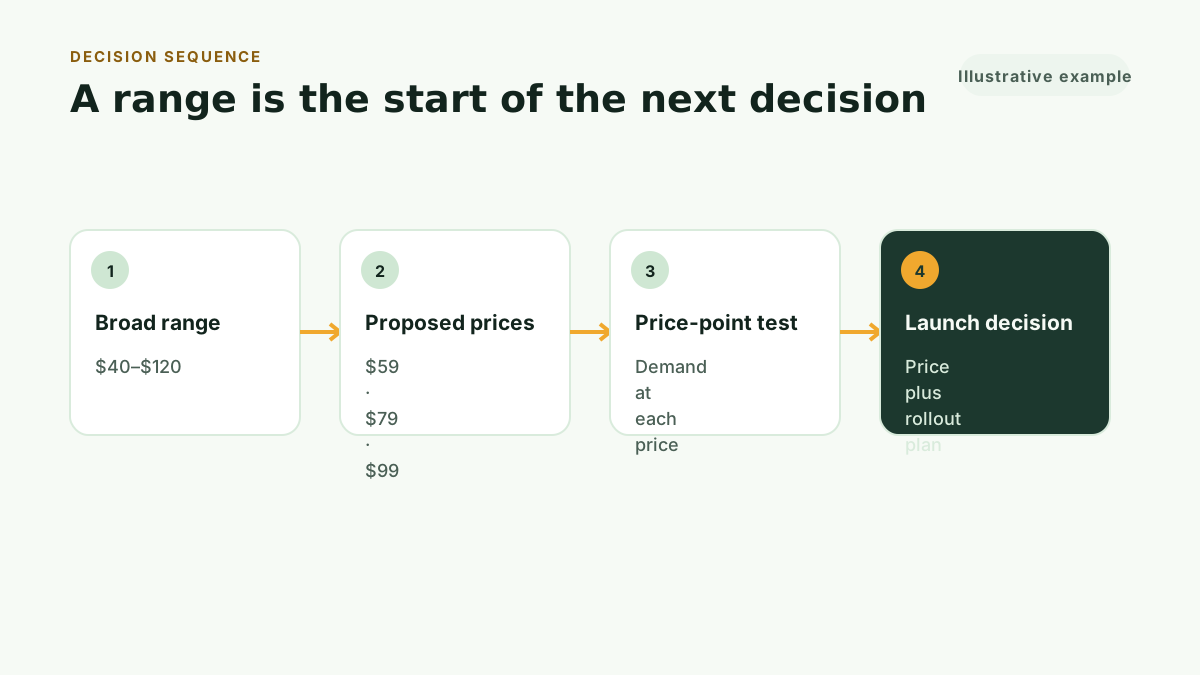
Turn the range into proposed prices
A range narrows your search. It does not finish it.
Suppose a study produces an acceptable range from $49 to $99. You could choose $59, $79, and $99 as proposed prices for a Gabor-Granger study. That second study would ask customers about purchase intent at those price points and compare modeled revenue.
You can also use the range to review an existing price:
- A price below the lower boundary may weaken credibility or leave money untested.
- A price inside the range may deserve a more precise demand test.
- A price above the upper boundary needs a strong reason, a different package, or a different customer segment.
Add the business constraints
Customer research answers part of the pricing decision. Add the constraints that customers cannot calculate for you:
- Gross margin and service cost
- Acquisition and sales cost
- Support load
- Contract structure
- Expansion path
- Positioning
- Rollout risk
A price can sit inside the acceptable range and still fail your business model. Another price can sit near the upper boundary and work because the offer carries a stronger package, service level, or outcome.
The goal is a decision supported by customer evidence and business facts.
Avoid five common mistakes
Copying a competitor range
Competitor prices describe their product, brand, packaging, and customer mix. Use them as market context. Research your own offer with your own audience.
Asking a broad audience
Large response counts cannot correct weak audience fit. Recruit buyers who can judge the product.
Hiding the billing unit
State monthly or annual billing, per-seat or account pricing, and included usage before the questions.
Treating OPP as a revenue maximum
The Van Westendorp OPP balances two perception curves. Use Gabor-Granger or a controlled market test to compare demand at proposed prices.
Ending with the chart
Record the proposed prices, the decision owner, the next test, and the outcome you will monitor.
Run this method with your users
Kinetic Pro includes unlimited customer-recruited studies across all four methods and Kinetic Workspace for $99 per month or $990 per year. The monthly plan starts with a 30-day free trial: card required, cancel anytime.
For a single decision, Kinetic Pricing’s Advanced Van Westendorp study costs $149. You describe the product and customer, share the generated survey with your audience, and receive the acceptable range, the four intersection points, charts, sample guidance, and a decision-focused narrative.
Start 30-day free trial to run this method with your users, or Buy one study when you need the credible range before the final price.