
Use a discrete choice experiment when the decision involves competing products, packages, features, and prices. Start with a well-designed choice task and a baseline multinomial logit model. Add nested, mixed, latent-class, or probit complexity only when the substitution patterns or preference differences in the data justify it, then validate the modeled pricing output against observed behavior.
What Discrete Choice Modeling Can Tell You
Discrete choice modeling estimates which alternative a person selects from a finite choice set by modeling utility and choice probabilities. In practical terms, the respondent repeatedly chooses among product profiles rather than assigning a score to one feature or ranking a list in isolation. The [Columbia Mailman School of Public Health's overview of discrete choice methods] explains this utility-based foundation.
That structure makes a discrete choice experiment useful when a SaaS team must compare packages, feature combinations, service levels, or prices in a competitive context. A choice task is structurally closer to selecting among competing purchase options than an isolated rating or ranking. Academic literature distinguishing DCE from traditional conjoint and [Greenbook's comparison of conjoint and discrete choice modeling] provide context for that distinction.
The underlying idea is Random Utility Maximization. Each alternative has a systematic utility component that can be related to its observed attributes, plus an unobserved error component. The assumed distribution of that error affects the model family and the interpretation of its choice probabilities. [Berkeley course notes on discrete choice methods] describe this conceptual basis.
The output is comparative evidence. Estimated utilities can help a team study feature trade-offs, package configuration, price sensitivity, willingness-to-pay, or simulated choice shares under specified scenarios. These are modeled outputs based on stated selections. They are not observed purchases, and they should not be described as guaranteed market share or revenue.
Method: Build the Choice Study Before Choosing the Model
A defensible workflow begins with the decision, not the statistical specification.
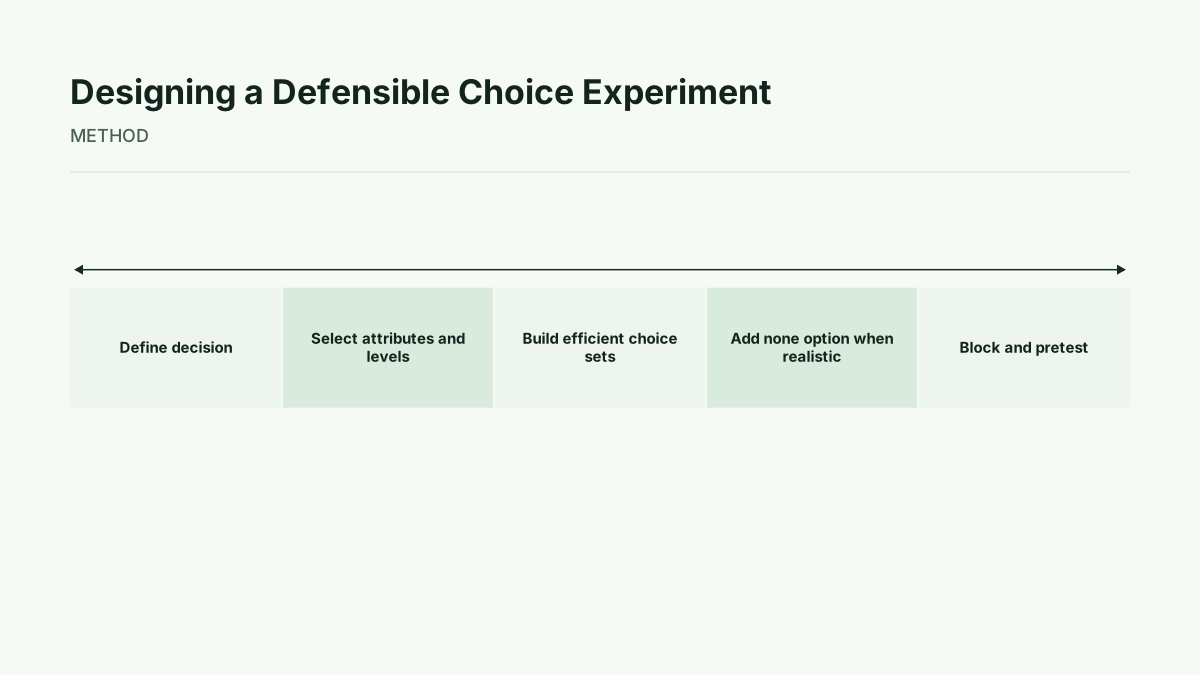
- Define the decision. State whether the team is choosing a price band, package structure, feature bundle, or competitive configuration. The model should answer a concrete question about alternatives.
- Select lean attributes and levels. Include the product characteristics that matter to the decision and represent them with realistic levels. Excessive attributes can overload the task and make interpretation harder.
- Build choice sets. Combine profiles into choice tasks that provide efficient coverage of the attributes and levels. The design should create enough variation to estimate the trade-offs the decision requires.
- Include a none option when appropriate. If declining all presented alternatives is realistic in the decision context, the choice task should represent that possibility rather than forcing a selection that does not reflect the market situation.
- Block and pretest. Blocking distributes the task burden across respondents. Pretesting checks whether the profiles, wording, and price levels are understandable and plausible. Attention checks provide another quality safeguard.
- Reserve holdout tasks. Keep some choice tasks apart from model estimation so the model can be tested on choices it did not use to fit its parameters.
Choice-study quality depends on these design decisions, not sample size alone. CEMMAP's research on experimental design supports treating attribute count, blocking, efficient coverage, none options, pretesting, and attention checks as part of the method. The [pricing survey design] discussion is also relevant when translating a pricing question into respondent tasks.
The practical implication is important: a more complex model cannot repair an unclear decision, overloaded questionnaire, unrealistic level, or weak choice design.
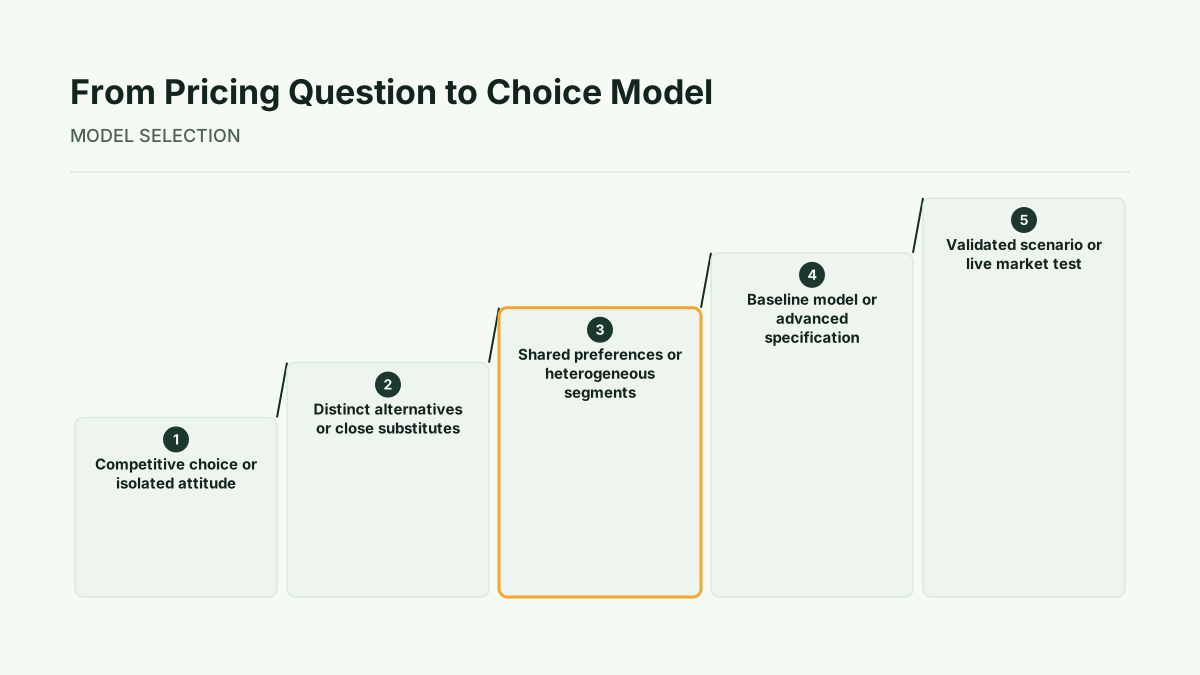
Select the Simplest Model That Matches the Data
Model selection should follow the choice structure and the evidence of model inadequacy.
- Binary choice models fit decisions with two alternatives, such as selecting one package versus another. They are appropriate when the choice set is genuinely limited to two options.
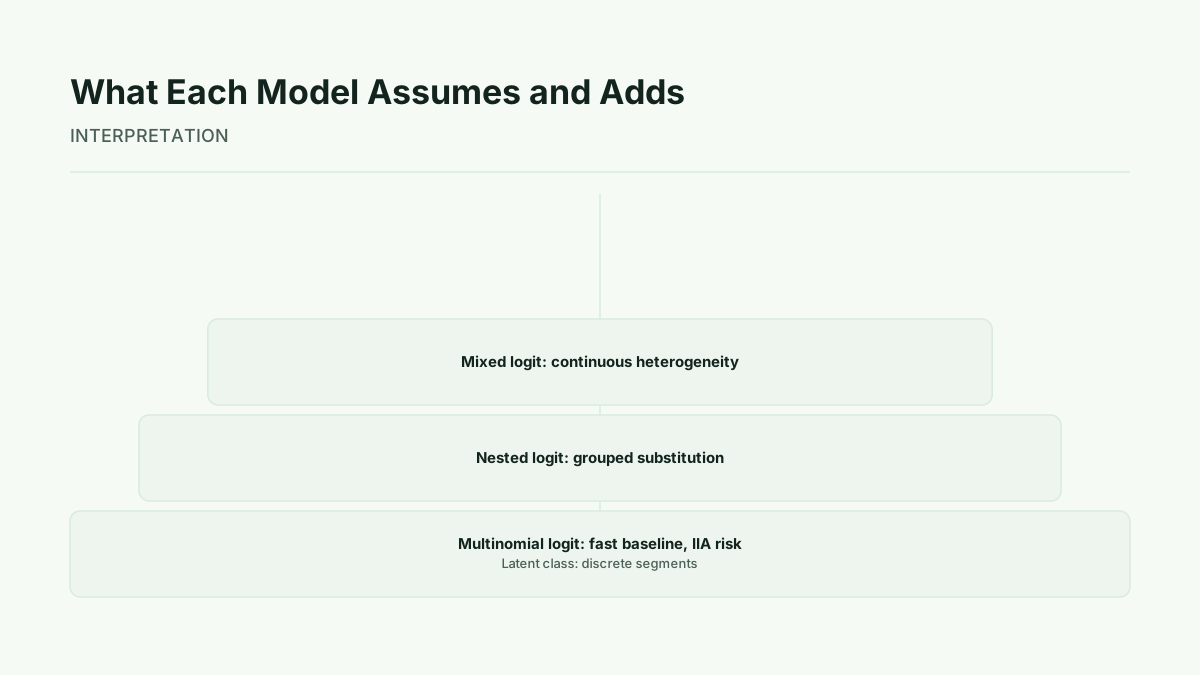
- Multinomial logit is a practical baseline for multiple unordered alternatives. It is comparatively direct to estimate and provides a clear starting point for utilities and choice probabilities. Its Independence of Irrelevant Alternatives assumption can misrepresent substitution among close alternatives, so it should not be treated as universally adequate.
- Nested logit can represent grouped alternatives when substitution within a group differs from substitution across groups. It adds structure where the alternatives have meaningful relationships.
- Mixed logit addresses continuous preference heterogeneity by allowing preferences to vary across people. It can be useful when a single average preference pattern does not represent the respondents well, with additional estimation complexity.
- Latent-class models represent discrete preference segments. They are useful when the decision calls for segment-level interpretation, but the number and meaning of classes require care.
- Probit models offer flexible correlation structures through a different error-distribution assumption, with heavier computational demands.
Nested, mixed, latent-class, and probit specifications each address different forms of correlated alternatives or preference heterogeneity. They also bring additional estimation complexity. Berkeley course notes on discrete choice methods provide the source framework for comparing these model families.
The decision rule is therefore simple: begin with multinomial logit for a multiple-alternative baseline, inspect diagnostics and substitution behavior, and escalate only when the added specification solves a defined problem.
Interpretation: Turn Utilities Into Pricing Evidence
Estimated coefficients describe how attributes relate to utility within the modeled choice process. A price coefficient and an attribute coefficient can be combined to derive willingness-to-pay for that attribute. Simulated choice shares can estimate how specified scenarios change predicted selections across alternatives. These calculations turn a choice model into evidence for comparing price bands or package configurations, rather than merely describing preferences.
Interpretation must preserve the difference between three evidence types:
- Stated intent: what respondents selected in the survey tasks.
- Modeled output: utilities, willingness-to-pay estimates, elasticities, or simulated shares calculated from the fitted model and specified scenarios.
- Observed behavior: what customers actually do in a live market, such as conversion or revenue outcomes.
The first two can inform a pricing hypothesis. Neither is interchangeable with the third. A model may support a preferred price band because its scenarios produce a more defensible trade-off, but that result remains modeled evidence until tested with customer behavior.
Validate Before Acting on a Simulation
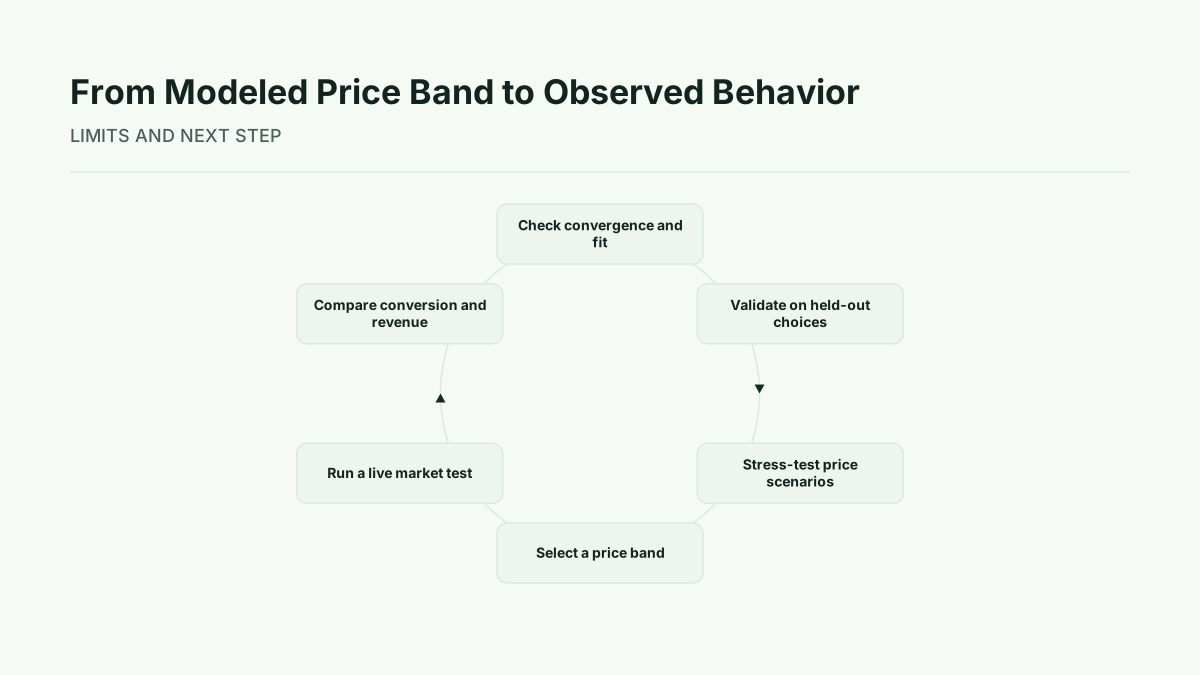
Before a modeled price band guides a decision, check whether the model is behaving credibly. Start with convergence checks so the estimation process has reached a stable result. Compare model fit rather than selecting an advanced specification solely because it is more flexible. Use the reserved holdout tasks to assess performance on choices that were not used for estimation.
Then compare predicted baseline or market shares with sensible reference points where such checks are available. Run sensitivity analysis across plausible price and package scenarios. Inspect whether substitution patterns make sense, especially when alternatives are close substitutes and the baseline model's Independence of Irrelevant Alternatives assumption may be strained.
These checks do not transform stated choices into observed purchases. They establish whether the model is internally and comparatively useful for the decision. The validation framework of Berkeley course notes on discrete choice methods supports convergence checks, fit comparisons, holdout validation, and baseline or market-share checks before results guide action.
Limits: Where Discrete Choice Models Can Mislead
A choice model can mislead when the study asks respondents to process too many attributes, uses poor blocking, or presents price levels and profiles that do not feel realistic. Forced choices can also distort the task when declining all alternatives is a plausible response. These are design risks, not merely modeling details.
Ignoring preference heterogeneity can make an average estimate appear more representative than it is. Likewise, close alternatives can expose the limitations of the Independence of Irrelevant Alternatives assumption in multinomial logit. Sample mismatch creates another interpretive limit: the modeled choices describe the studied respondents and design, not automatically every potential customer.
Finally, survey choices, modeled predictions, and observed customer behavior are different forms of evidence. They should not be presented as interchangeable. Without an article-specific dataset, model output, confidence interval, or observed customer outcome, no particular market share, revenue result, willingness-to-pay value, or elasticity can be asserted here.
Next step: Move From Model Output to a Testable Price Decision
Use the validated model to select a defensible price band or package configuration, not to declare a final market outcome. Document the scenario assumptions, the relevant utilities, the uncertainty or sensitivity checks available, and the reason the selected option answers the original business decision.
Then run a live market test where feasible. Monitor conversion and revenue, compare those observed outcomes with the model's predictions, and update the research view with customer behavior. This sequence keeps the model in its proper role: a structured way to evaluate trade-offs and form a pricing hypothesis before the market supplies stronger evidence.
For teams ready to turn pricing analysis into a decision, see Kinetic Pricing's plans.
Additional context on these methods is available from academic literature distinguishing DCE from traditional conjoint, comparing SaaS packages with conjoint analysis, turning pricing analysis into a decision, free SaaS pricing research and benchmarks, self-serve pricing research versus a consultant, AMAUTA Public Affairs' guidance on managing pricing strategy change, Discrete Choice Model and Analysis — Columbia Mailman School of Public Health, Discrete Choice Methods (Berkeley course notes), Distinguishing discrete choice experiments from traditional conjoint (academic paper) and Conjoint vs discrete choice overview — Greenbook.
Run this method with your users
Start 30-day free trial to run every method with your users, or Buy one study when one decision needs evidence now.
Sources
Columbia Mailman School of Public Health, “Discrete Choice Model and Analysis”
University of California, Berkeley, “Discrete Choice Methods” course notes
University of Technology Sydney, “Distinguishing discrete choice experiments from traditional conjoint”
Greenbook, “Conjoint vs discrete choice overview”
CEMMAP, “Breaking the curse of dimensionality in conditional moment inequalities for discrete choice models”