
A pricing leader should choose a segmented discount experiment with a holdout group, a predefined margin floor, and an incremental-profit KPI. Do not judge a broad or recurring promotion by higher sales alone. First establish the research signal, match the discount format to the objective, test it against a control, and review economics after the promotion ends.
Targeted Discounts: The Research Signal
The central distinction is between selling more during a promotion and creating more profit because of it. Stacked discounts can increase initial sales while also increasing return costs and weakening net profitability under some cost structures. The cited research reports that model-based pricing strategies improved profits by [7% to 31%] relative to frequent or stacked promotional approaches. Treat that range as study-specific evidence, not as a forecast for your business.
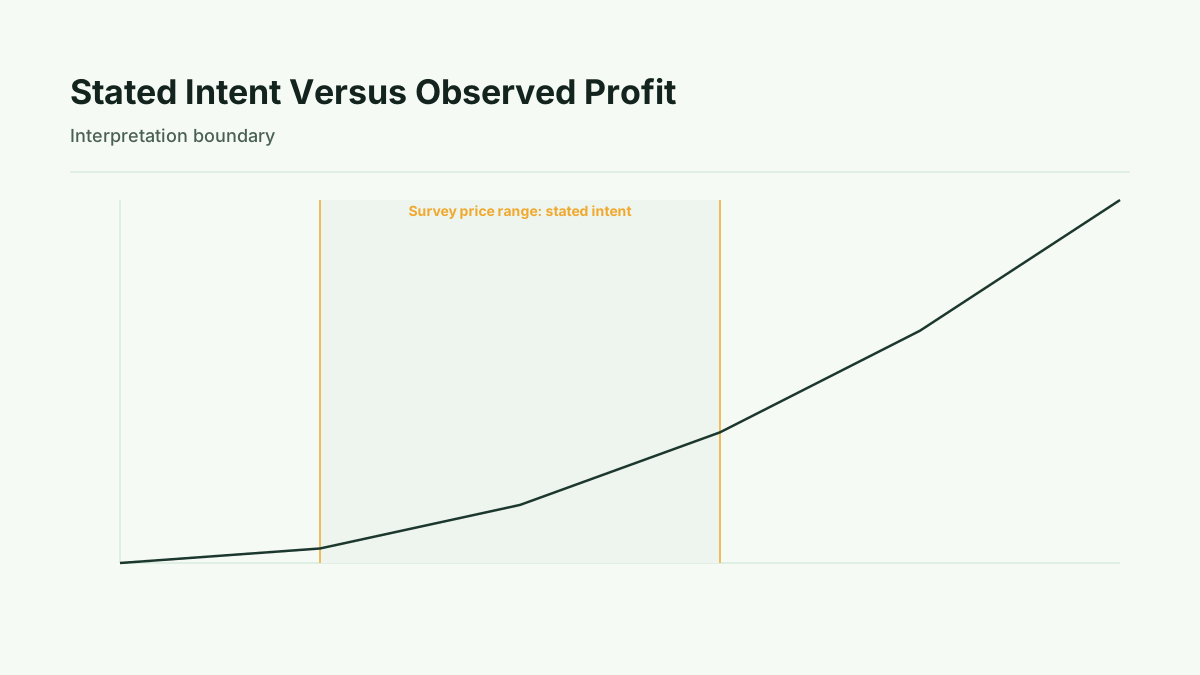
The evidence also comes in different forms. A survey can capture what people say they would consider or buy. A pricing model can estimate how a strategy might perform under its assumptions. A live experiment can observe offer response, order economics, and returns. These are not interchangeable results. In particular, modeled or simulated profit is not observed commercial profit, and stated purchase intent is not observed purchase behavior.
This makes targeted discounting a testable profit-management choice rather than a universal prescription. Smaller and more precise discounts can preserve margin while supporting sales better than frequent, broad discounts, but the appropriate depth, audience, and timing remain dependent on customer behavior and economics.
Match the Discount to the Business Objective
Start with the job the discount must perform. A percentage-off offer can be a hypothesis for acquisition or reactivation. A dollar-off offer can test whether a clear absolute saving changes conversion. A buy-one-get-one structure can test a basket-building or clearance objective. A free-shipping threshold can test average-order-value behavior. A tiered discount can test whether a simple rule improves retention or recovery without requiring individual-level precision.
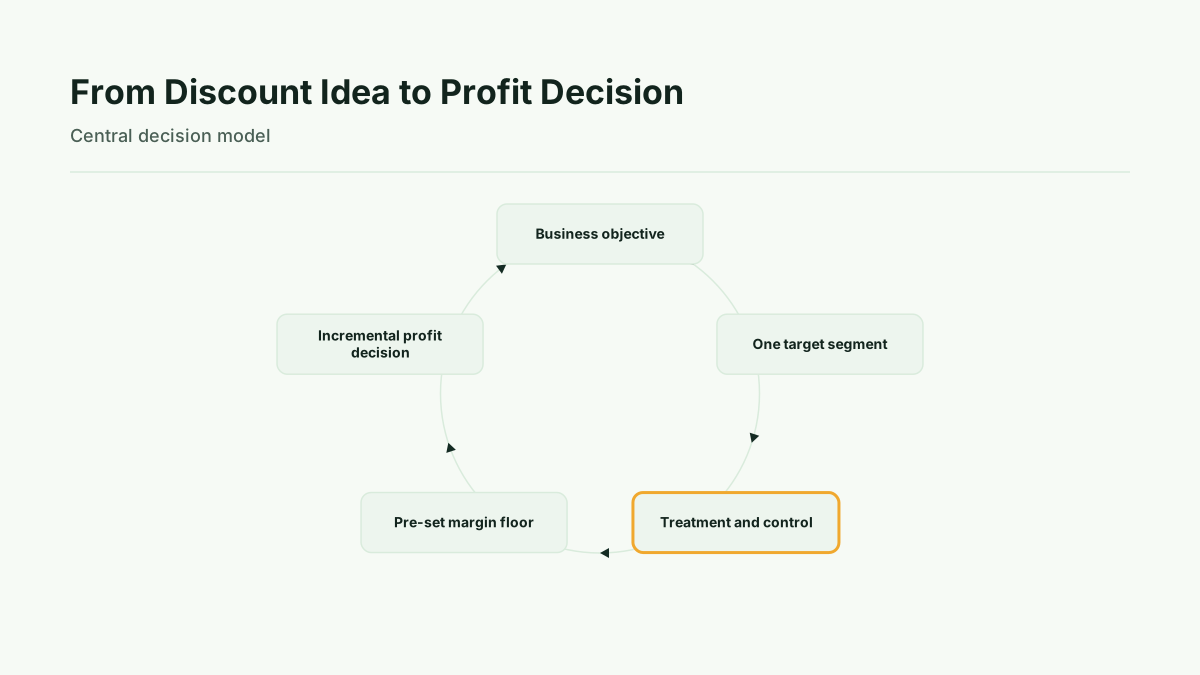
These are starting hypotheses, not conclusions. Write each one in a form that can be measured: a defined segment receives a defined offer, compared with a control, and the result is evaluated against a margin floor. The margin floor should account for the discount and any relevant return costs before launch. A promotion that raises revenue but falls below the floor should not pass simply because its sales count is higher.
Keep the initial design narrow. One objective, one segment, and one principal offer make interpretation easier than combining acquisition, clearance, and retention in one campaign. If the business needs several objectives, treat them as separate experiments or as explicitly separated cells with their own hypotheses and economic thresholds.
Design a Credible Discount Experiment
The basic design has a treatment group that receives the discount and a control or holdout group that does not. Define the segment before assignment, record the hypothesis, select one primary KPI, and identify secondary KPIs that explain the result. Incremental profit should be the primary economic decision metric. Revenue, conversion, average order value, discount-to-revenue ratio, return costs, and retention can serve as supporting measures.
Sample-size considerations and test duration should be set before launch. The test needs enough traffic and a reliable attribution method to distinguish an offer effect from ordinary variation. A holdout group helps estimate the incremental effect of a promotion after the sale ends instead of attributing all in-window sales to the discount.
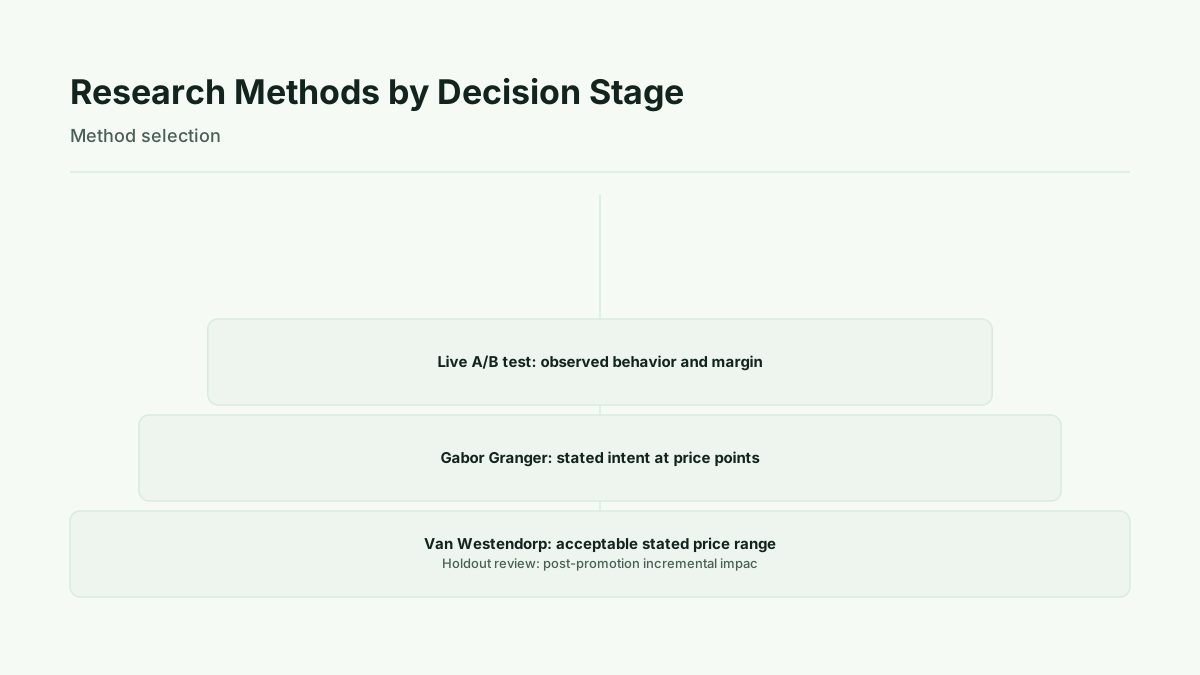
Use the right research method for the right decision stage. Van Westendorp measures a stated acceptable price range. Gabor Granger measures stated purchase intent at specified price points. Neither measures observed purchase behavior. Use those methods to narrow a test range or frame candidate price points, not to declare that a discount will produce a particular profit result. A live A/B test measures observed response, while a post-promotion holdout review helps separate promotion effects from sales that would have occurred anyway.
A practical sequence is therefore: use price research to define plausible boundaries, run the offer against a control, measure observed order economics, and continue tracking the holdout after the promotion ends. The research boundary and the live result should remain labelled separately.
When Personalization and Timing Backfire
Personalization is not automatically better than a simple policy. Highly tailored discounts can increase customer search or comparison behavior in some settings. That makes a simple two-tier policy a relevant alternative to individual-level precision. A useful comparison is not “personalized versus nothing,” but “simple, bounded tiers versus more granular targeting,” with both evaluated against the same profit criteria.
Timing also requires a specific hypothesis. Randomized discount timing can outperform fixed timing under particular customer-segmentation and inventory conditions. When those conditions do not hold, timing can encourage customers to wait. Test timing only when the business can define the relevant segment and inventory context, and include a holdout that remains outside the promotion.
Avoid allowing a temporary test to become a predictable entitlement. Set access limits, frequency caps, and an end condition before launch. If customers can repeatedly anticipate the offer, later purchases may become difficult to interpret because the promotion itself has become part of the expected buying pattern. That is a warning to review dependency, not proof that every recurring promotion fails.
Measure Incremental Profit After the Promotion
Revenue is an incomplete decision metric. Review incremental profit, margin per order, discount-to-revenue ratio, return costs, and the difference between treatment and holdout. Then examine retention at 60 days and 90 days, where relevant to the business model. These windows are review points, not guaranteed outcomes or universal standards.
Also inspect effect size, cannibalization, and attribution. A discount may receive credit for an order that would have happened without it. It may shift demand between products, customers, or timing windows without creating additional profit. The holdout provides a comparison for estimating the incremental effect, while post-promotion review shows whether the apparent gain persists or reverses.
Create explicit warning signals for discount dependency. Examples include repeated use by the same customer segment, weaker full-price response after the test, or economics that remain below the margin floor after return costs. These are review triggers. They should lead to a documented decision to stop, revise, or continue, rather than an automatic rollout.
Guardrails and the Discount-Test Playbook
Method: Synthesize the supplied peer-reviewed, working-paper, practitioner, and operational evidence while separating stated purchase intent, modeled or simulated outcomes, and observed live behavior. Convert that evidence into a segmented experiment with a holdout and a margin-based evaluation.
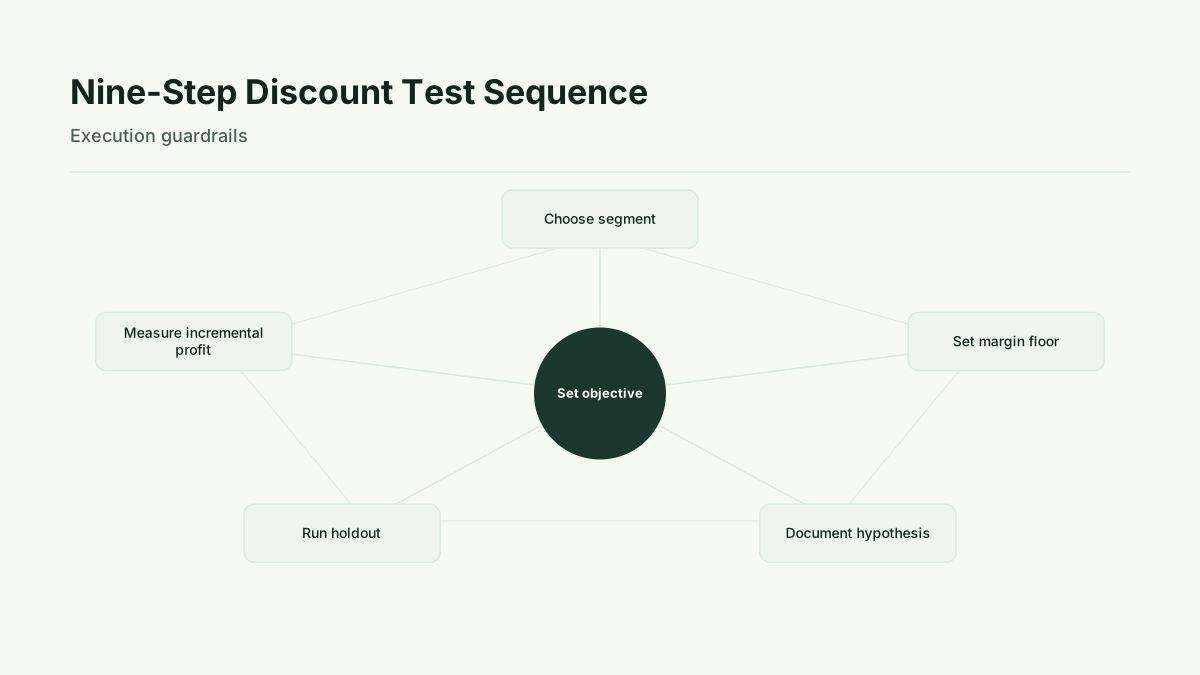
Use this operating sequence:
- Set one business objective.
- Choose one customer segment.
- Select one discount format and document the hypothesis.
- Set the minimum margin per order before launch.
- Define treatment, control, primary KPI, and secondary KPIs.
- Run the holdout through the promotion and the post-promotion review period.
- Measure incremental profit, margin, returns, attribution, and retention.
- Ramp gradually only if the result clears the margin floor.
- Review on a fixed cadence and apply frequency caps, access limits, and exit conditions.
Interpretation: Targeted discounting is supported as a narrower and more disciplined alternative to frequent, broad promotions, but the evidence does not establish one best discount depth or timing for every business. The decision should follow the measured incremental-profit result, not the largest sales number.
Limits: The [7% to 31%] range is context-dependent and should not be treated as a forecast. Practitioner discount guidance, survey outputs, timing findings, personalization findings, and 60-day and 90-day retention checks are also context-dependent. Simulated or modeled outcomes are not observed commercial results. Live tests require adequate traffic and reliable attribution.
Next step: Choose one objective and one customer segment, define the minimum margin per order, select a control or holdout, and use price research to narrow the test range before launching a live discount experiment. Kinetic Pricing provides methods for price-range finding, price-point testing, feature-value ranking, and package-and-price construction. Review Kinetic Pricing plans when a structured research step would help define the test.
Additional context on these methods is available from HBR's analysis of pricing behavior, 13%, 20%, guide to pricing survey questions, pricing research without a consultant, Cowles Foundation working paper, pricing analysis guide, Kinetic Pricing research page, self-serve research approach against hiring a consultant, Kinetic Pricing's plans, Personalized discounts and consumer search (Cowles Foundation working paper, 2025), When Should We Offer a Discount? Randomized Discount Timing with Strategic Customers (MPRA), Smaller, More Precise Discounts Could Increase Your Sales (HBR), Explore Kinetic Pricing and 13%.
Run this method with your users
Start 30-day free trial to run every method with your users, or Buy one study when one decision needs evidence now.
Sources
- Iowa Research Online, “On the Profitability of Stacked Discounts: Identifying Revenue and Cost Effects of Discount Framing.”
- MPRA, “When Should We Offer a Discount? Randomized Discount Timing with Strategic Customers.”
- Cowles Foundation, “Personalized discounts and consumer search.”
- Harvard Business Review, “Smaller, More Precise Discounts Could Increase Your Sales.”
- Kinetic Pricing, “Pricing Survey Questions.”
- Kinetic Pricing, “Pricing Research Without a Consultant.”