
If your team needs a defensible pricing or packaging decision, run a small pilot first. Then choose the method that matches the required deliverable: CBC or another conjoint design for market simulation and modeled willingness to pay, MaxDiff for feature prioritization, and qualitative research when the choice pattern alone does not explain customer reasoning. The central rule is simple: select the output before selecting the software.
Best Conjoint Tools Start With the Decision, Not the Feature List
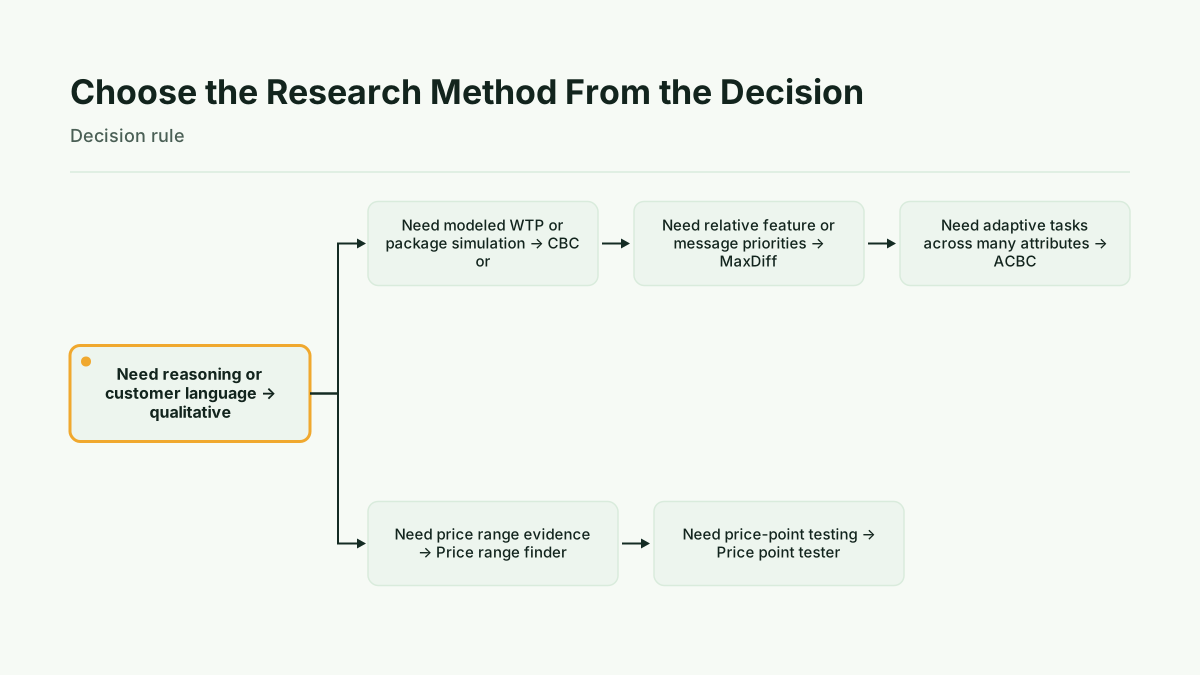
A pricing team may be asking several different questions under the label “conjoint.” It may need to compare packages, estimate trade-offs between features and price, rank messages, find a plausible price range, test specific price points, or understand the language customers use when explaining a choice. Those questions do not all require the same method.
Conjoint estimates stated trade-offs among the attributes and levels included in a study. It does not directly measure underlying reasoning or observed purchase behavior. That boundary is important when a survey result is later used in a pricing recommendation. Conjoint analysis quantifies these trade-offs directly from choice data, while the history of measuring consumer judgments provides context for the approach.
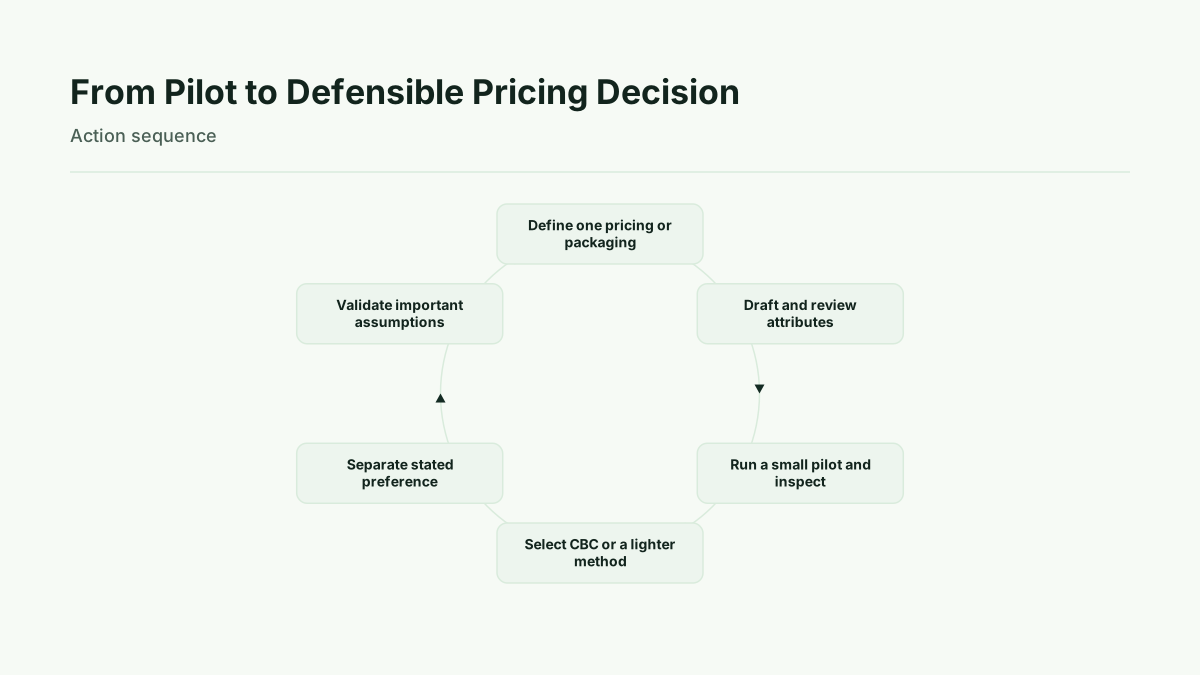
Use one decision rule throughout procurement: define the decision, name the output required, run a pilot, and only then commit to a full study or longer-term tool arrangement. A pilot is not proof that a vendor is universally best. It is a check that the proposed task is understandable and that the resulting output can support the decision in front of the team.
Match the Research Method to the Deliverable
Choice-based conjoint, or CBC, presents choice tasks built from attributes and levels. It uses those choices to estimate attribute-level utilities and can support market simulation when the design and model specify the relevant assumptions. This makes CBC the natural branch when the team needs to compare packages or model scenarios involving price and features. The output remains stated preference and modeled output, not observed purchase behavior.
Adaptive choice-based conjoint, or ACBC, can be considered when the study needs adaptive stated-choice tasks across many attributes. Its fit should still be tested in a pilot, because the required deliverable is more important than the method label. If the team needs a package-and-price simulator, it should confirm that the chosen implementation actually produces that output.
MaxDiff is a lighter branch when the question is relative prioritization. It is appropriate for ranking features, messages, or other items when a full package-and-price simulation is not required. It does not replace a package simulator simply because both methods ask respondents to choose among alternatives.
PAPRIKA can support pairwise decision priorities. Price-range research addresses a range question, while price-point testing addresses reactions to specified points. Qualitative probes address explanations, vocabulary, and reasoning that a structured choice task does not capture. The method should follow the deliverable rather than the perceived sophistication of the software.
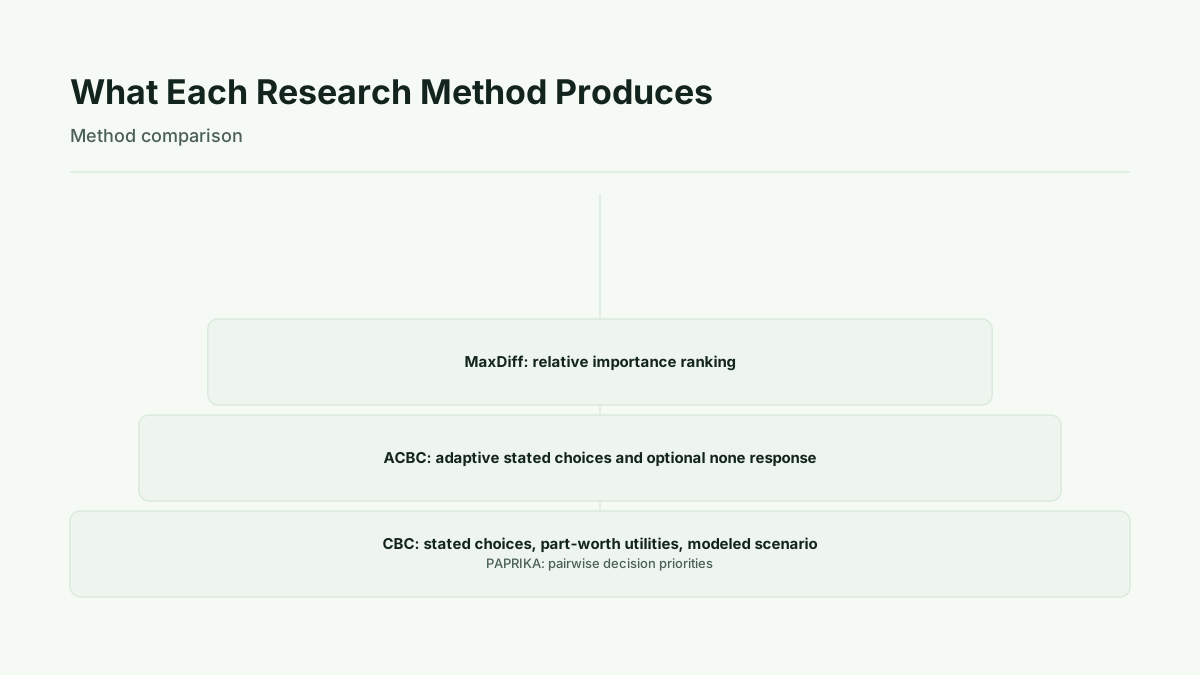
A useful comparison is: CBC for stated choices, part-worth utilities, and modeled scenario share; ACBC for adaptive stated choices and an optional none response; MaxDiff for relative importance ranking; PAPRIKA for pairwise priorities; and qualitative probes for explanations and attribute language. If the team cannot describe the final deliverable in one sentence, it is not ready to compare vendors.
Evaluate Conjoint Software With a Procurement Scorecard
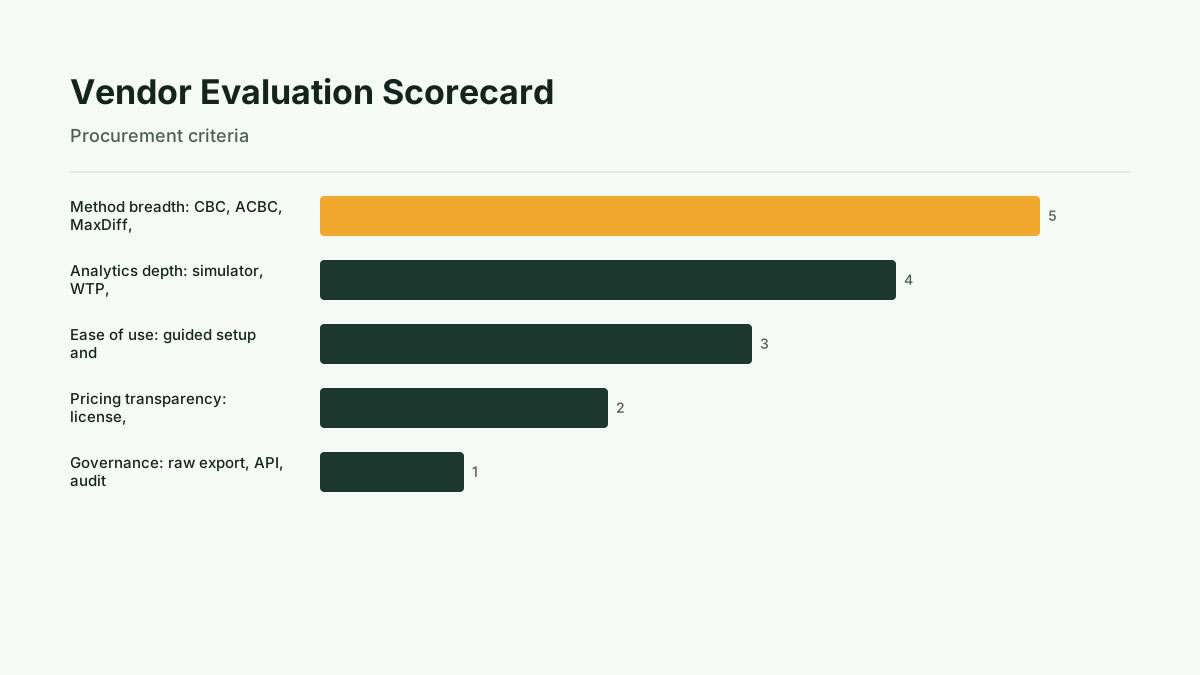
A practical scorecard should cover five decision areas, with supporting checks underneath each one.
First, assess method breadth. Can the tool support the method the pilot requires, including CBC, ACBC, MaxDiff, or PAPRIKA where relevant? Breadth is useful only when it connects to a real research decision.
Second, assess analytics depth. Ask whether the workflow provides part-worth utilities, segmentation, market simulation, and modeled willingness-to-pay outputs when those are required. Confirm what assumptions are visible to the analyst rather than treating a dashboard label as an explanation.
Third, assess usability and workflow. Review guided setup, attribute and level editing, survey review, fielding workflow, data inspection, and export. A tool can be methodologically broad yet operationally unsuitable for the team that must create, audit, and explain the study.
Fourth, assess cost structure. Separate software or license costs from response, panel, implementation, and support costs. Do not treat a displayed platform price as a complete study quote. Vendor-by-vendor prices and comparative performance are not established here, so the scorecard should collect those details directly.
Fifth, assess governance and reproducibility. Request raw choice-task export, documentation of model settings, reproducible analysis steps, audit history where available, privacy terms, and support boundaries. A vendor evaluation should check raw export, analytics and simulation capabilities, sample and panel terms, workflow, governance, reproducibility, and total cost structure. Conjoint analysis and Pew Research Center's guidance on writing survey questions provide useful foundations for reviewing both the analytical and wording sides of the workflow.
Understand What Conjoint Outputs Mean
Part-worth utilities represent estimated preferences for the tested attribute levels within the study design. They are not a transcript of why a respondent chose an option. CBC can use these estimates to produce a market simulation, but the simulated result depends on the tested alternatives, model, sample, and assumptions used to define the scenario.
Modeled willingness to pay is also an inference from the design. It should not be described as a guaranteed price customers will pay. A simulated revenue scenario is a model output, not revenue observed after launch. Stated purchase intent is a survey response, modeled revenue is calculated from assumptions, and observed behavior requires transaction or post-launch evidence. These three evidence types must remain separate in an executive readout.
This distinction changes how results should be presented. Instead of saying that a package “will win,” describe the package as producing a modeled result under the stated design and assumptions. Instead of saying respondents “bought” a price, describe their stated response to the tested choice. The more consequential the decision, the more important it is to preserve that language.
Plan the Pilot, Sample, and Operating Workflow
Begin with one pricing or packaging decision. Draft a limited set of attributes and levels that directly represent that decision. Review every term for clarity, especially labels that could mean different things to different respondents. Clear attribute and level wording matters because ambiguous wording can introduce bias before responses are analyzed. Writing survey questions offers relevant guidance for this review.
Next, test the instrument with a small pilot and inspect comprehension, missing or unusable responses, task completion, and whether respondents interpret the attributes as intended. Any response-count or timing plan should be treated as planning guidance, not a universal guarantee. Subgroups may require separate consideration, and subgroup conclusions should not be treated as stable merely because a platform can display them.
Check the full operating path: build the tasks, review the wording, field the pilot, export raw data, reproduce the main calculations, and document the assumptions behind any simulation. Keep planning figures explicitly separate from vendor quotes. Any invented planning quantity would be an illustrative example and simulated, not a benchmark or promise.
Use a Demo or RFP to Test the Deliverable
Ask each vendor to show the exact deliverable your team needs rather than a generic product tour. Questions should include:
- Can the team export raw choice tasks and respondent-level data in a usable format?
- Which utility, segmentation, simulation, and modeled willingness-to-pay outputs are available?
- Can analysts inspect and reproduce the model settings and scenario assumptions?
- What are the sample, panel, privacy, response, support, and implementation terms?
- Which costs are recurring, usage-based, or charged separately?
- What happens if the team needs to revise wording after the pilot?
- Can the workflow preserve an audit trail and support a repeat study?
Set minimum governance thresholds before reviewing price. If a tool cannot provide the evidence needed to inspect, export, or reproduce the study, a lower apparent cost may not make it suitable for a consequential pricing decision.
Method
This article uses a decision-first comparison. Each method is mapped to its required deliverable, then each tool category is evaluated for method breadth, analytics, usability, transparency, and governance. The proposed workflow validates the match through a pilot before a full commitment. Planning quantities and timing are not universal guarantees, vendor quotes, or performance claims.
Interpretation
Use stated preference to describe what respondents selected in the research task. Use modeled or simulated revenue to describe a calculation based on those selections and explicit assumptions. Use observed behavior only for evidence from transactions or post-launch behavior. CBC and related conjoint methods estimate stated trade-offs. MaxDiff produces relative rankings rather than a full package-and-price simulator. Qualitative research adds explanations and language, but these evidence types should not be treated as interchangeable.
Limits
Conjoint cannot, by itself, explain every reason a respondent chose an option or establish observed purchasing behavior. Hypothetical bias, ambiguous attribute or level wording, correlated levels, omitted interactions, sample instability, and overinterpretation of subgroups can affect how results should be read. The supplied evidence does not establish comparative vendor performance, vendor-by-vendor pricing, revenue lift, customer outcomes, or a universal sample or timing requirement.
Next step
Write down the single pricing or packaging decision the team must make, define the output that would resolve it, and run one pilot against that requirement. If the pilot supports a package-and-price simulation, evaluate CBC or a comparable conjoint workflow. If it supports only relative prioritization, consider MaxDiff. If the output still does not explain the choice, add qualitative research or later observed-behavior validation. Explore Kinetic Pricing plans when reviewing a pricing research workflow.
Additional context on these methods is available from this roundup of feedback management tools, free pricing research and benchmarks, plans page, Pro tier, this comparison, Conjoint analysis — Wikipedia, A new way to measure consumers' judgments — Harvard Business Review and Writing survey questions — Pew Research Center.
Run this method with your users
Start 30-day free trial to run every method with your users, or Buy one study when one decision needs evidence now.
Sources
Wikipedia, “Conjoint analysis”
Harvard Business Review, “New Way to Measure Consumers’ Judgments”
Pew Research Center, “Writing Survey Questions”
Kinetic Pricing, “Pricing”
Kinetic Pricing, “Pro”