
Your selling price is the amount a customer pays for one unit of what you sell. Calculating it takes one line of arithmetic. Choosing it takes evidence.
Most pricing advice covers the arithmetic and stops. This covers both halves: the formulas that give you a defensible floor, and the research that tells you how much room sits above it.
The selling price formula
Two formulas cover nearly every case.
From cost and markup:
Selling price = cost × (1 + markup percentage)
A product that costs $100 to make, sold at a 25 percent markup, carries a selling price of $125.
From cost and target margin:
Selling price = cost ÷ (1 - target margin)
The same $100 product at a 20 percent target gross margin also lands at $125.
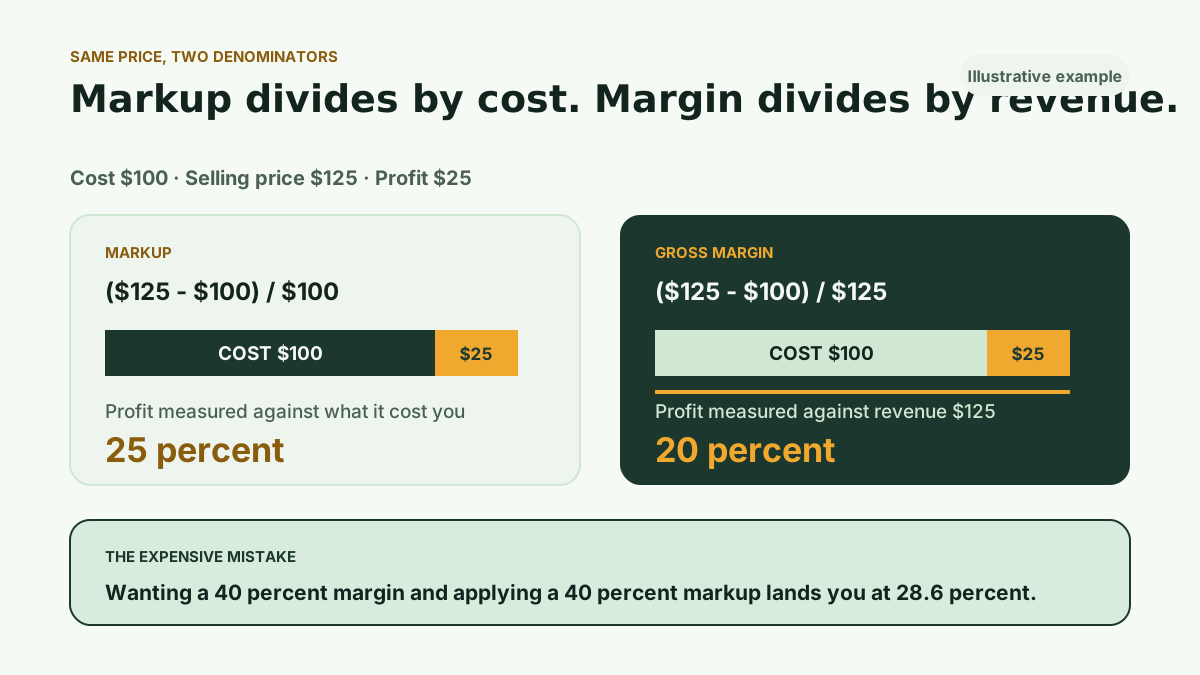
Both formulas describe the same $125. They divide the profit by different denominators, which is where most pricing spreadsheets go wrong.
Markup and margin are not the same number
Markup measures profit against cost. Margin measures profit against revenue.
- Markup percentage = (selling price - cost) ÷ cost
- Gross margin = (selling price - cost) ÷ selling price
For that $100 product sold at $125, the markup is 25 percent and the gross margin is 20 percent. Whenever you sell above cost, the markup number will be the larger of the two.
Teams lose real money on this confusion. A founder who wants a 40 percent gross margin and applies a 40 percent markup ends up with a 28.6 percent margin and a shortfall they discover at the end of the quarter.
Get the cost figure right first
The formula is only as good as the cost you feed it. Include every variable cost of delivering one unit.
For a physical product: materials, direct labor, packaging, inbound freight, payment processing, and the returns rate.
For software: infrastructure per account, third-party API charges you pass through, the support hours a typical account consumes, payment processing, and onboarding time if every customer gets some.
Leave fixed costs out of the unit calculation. Rent, salaries, and tooling do not change when you sell one more unit. They belong in the volume you need to cover them, not in the price of a single sale.
Software teams underestimate support. An account that generates four tickets a month at twenty minutes each carries a real cost that never appears in the infrastructure bill.
Cost-plus gives you a floor, not an answer
Cost-plus pricing sets the price from your costs. It has one genuine strength: it guarantees you do not sell below your own economics. It has one structural weakness: your costs have nothing to do with what the product is worth to the buyer.
Two products with identical costs can support prices that differ by a factor of ten. The difference sits in the outcome each one produces and the alternative each buyer is comparing against.
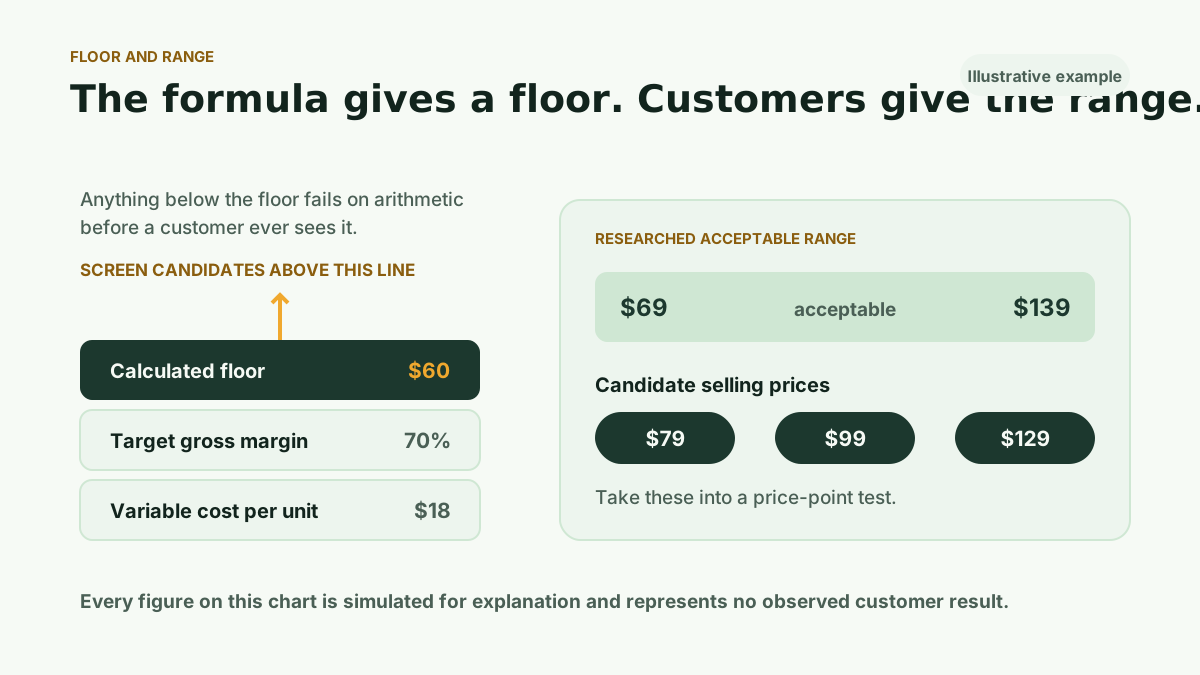
Use the cost-plus number as a screening floor. Anything below it fails on arithmetic. Everything above it is an open question that customer evidence answers.
Anchor the price on the customer's alternative
Before you research, find the number your buyer is comparing against. Every buyer has one:
- The incumbent product they pay for today
- The manual process and the hours it consumes
- The internal build and its opportunity cost
- Doing nothing and absorbing the problem
Price the outcome relative to that alternative. A product that saves a team ten hours a month against a fully loaded cost of $60 per hour has created $600 of monthly value, and the selling price is a share of that number rather than a multiple of your infrastructure bill.
Validate the price with customers
A calculated selling price is a hypothesis. Three methods test it.
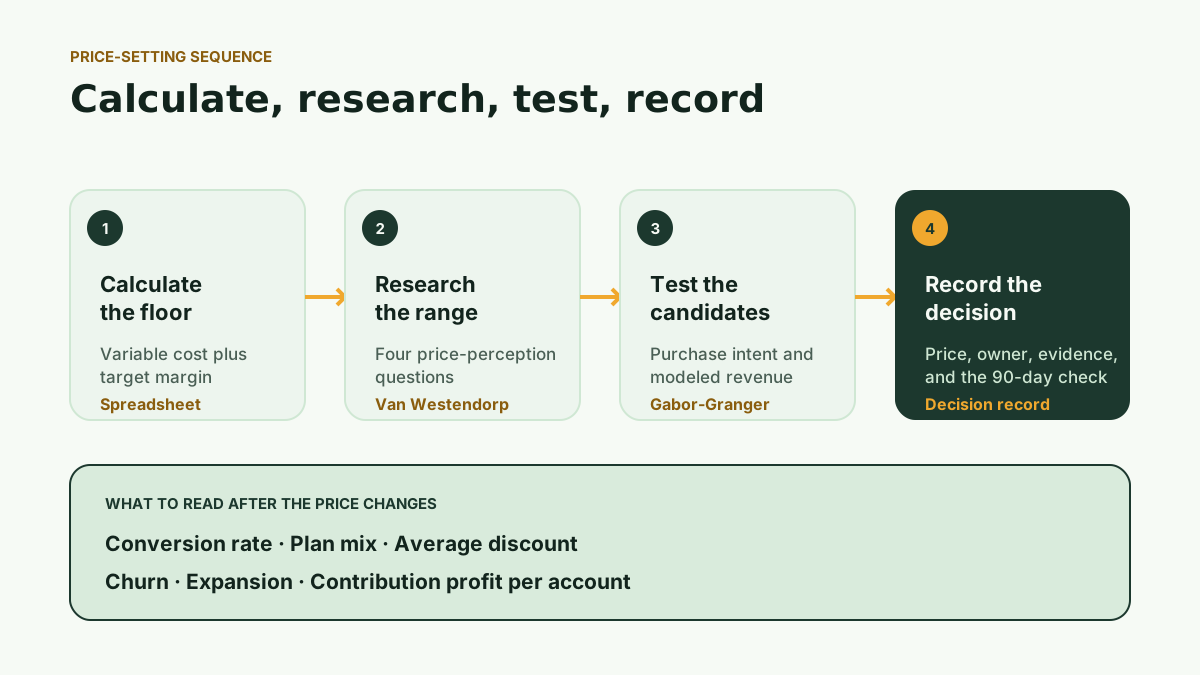
Find the acceptable range. Van Westendorp asks each respondent four price-perception questions and builds cumulative curves whose intersections define a lower and upper boundary. The range gives you a credible field for candidates. It does not forecast revenue.
Compare candidate prices. Gabor-Granger tests purchase intent at specific price points, builds a demand curve, and multiplies intent by price to model revenue at each tested point. Use it when you have three or four candidates from inside the range.
Test the whole offer. Conjoint analysis presents realistic packages so customers trade price against features and limits. Use it when the selling price and the contents of the package move together.
Stated intent runs ahead of observed purchase behavior in every survey-based method. Treat the result as a ranking of candidates and a directional estimate, then confirm with a live change.
Five selling price mistakes
Applying markup when you meant margin. Check the denominator every time.
Copying a competitor's price. Their price reflects their costs, their packaging, their brand, and their customer mix. Use it as market context and research your own offer.
Forgetting discounting. If your average deal closes at 15 percent off list, your realized selling price is not your list price. Set list with the discount pattern in view.
Pricing one unit and ignoring the mix. A price change moves customers between plans. Model the mix shift alongside the per-unit revenue.
Setting the price once. Costs move, competitors move, and your product gains capability. Put a pricing review on the calendar with the metrics you will read.
Record the decision and the check
When you choose a selling price, write down the number, the evidence behind it, the person who owns it, and the metric you will read in ninety days. Conversion rate, plan mix, churn, and contribution profit belong on that list.
Kinetic Workspace keeps that record attached to the study it came from, so the next pricing conversation starts from evidence.
Research the price before you publish it
Kinetic Pricing runs four self-serve study methods on customers you recruit yourself: Advanced Van Westendorp at $149 for the acceptable range, Gabor-Granger at $199 for candidate price points and modeled revenue, MaxDiff at $279 for feature priorities, and CBC Conjoint at $499 for package trade-offs.
The analysis is deterministic. The written narrative gets code-checked against the math, so no figure in your report is invented.
Kinetic Pro includes unlimited customer-recruited studies across all four methods, three seats, and Kinetic Workspace for $99 per month or $990 per year.
Choose a study method and put a number behind your next price.