
Most teams pick a customer research method the way they pick a lunch spot. Someone suggests interviews, nobody objects, and six weeks later the notes sit in a doc that never settles the argument that started the project.
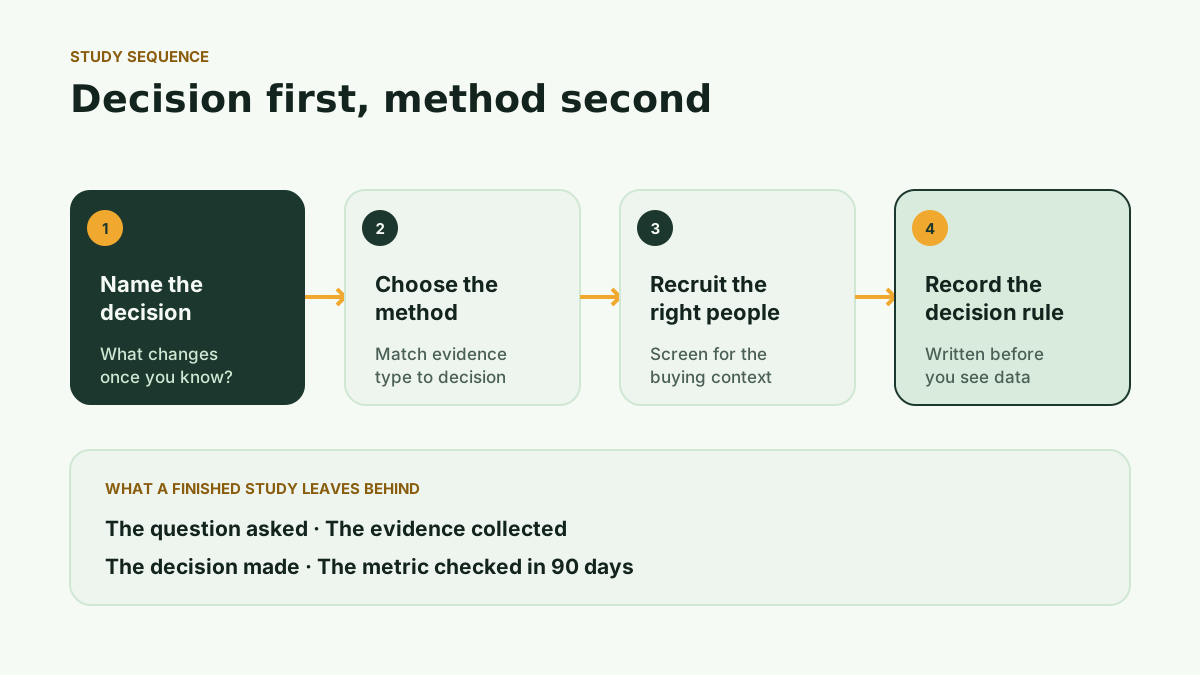
Start from the other end. Name the decision you owe, then choose the method that produces evidence for it. A method that cannot change what you do next is a method you should skip.
Three questions separate every method
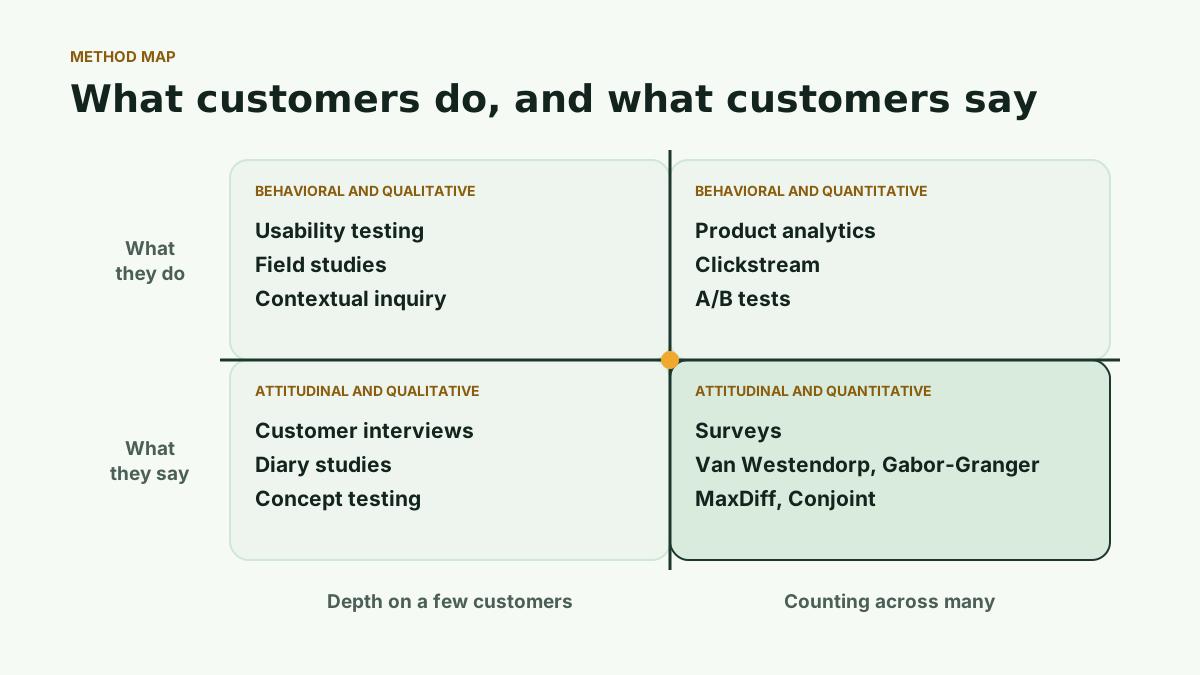
The Nielsen Norman Group maps research methods along three dimensions, and the same map works for product, marketing, and pricing decisions.
Attitudinal or behavioral. Attitudinal research records what customers say they believe, want, or would pay. Behavioral research records what they did. A survey about desired features is attitudinal. Analyzing which features accounts actually opened last quarter is behavioral.
Qualitative or quantitative. Qualitative work observes a small number of customers closely and allows follow-up questions. Quantitative work collects predetermined data from a larger group and analyzes it mathematically. Depth on one side, counting on the other.
Context of use. Some methods watch customers use the product in their own work. Some script a task. Some show a prototype. Some ask questions with no product in the room at all.
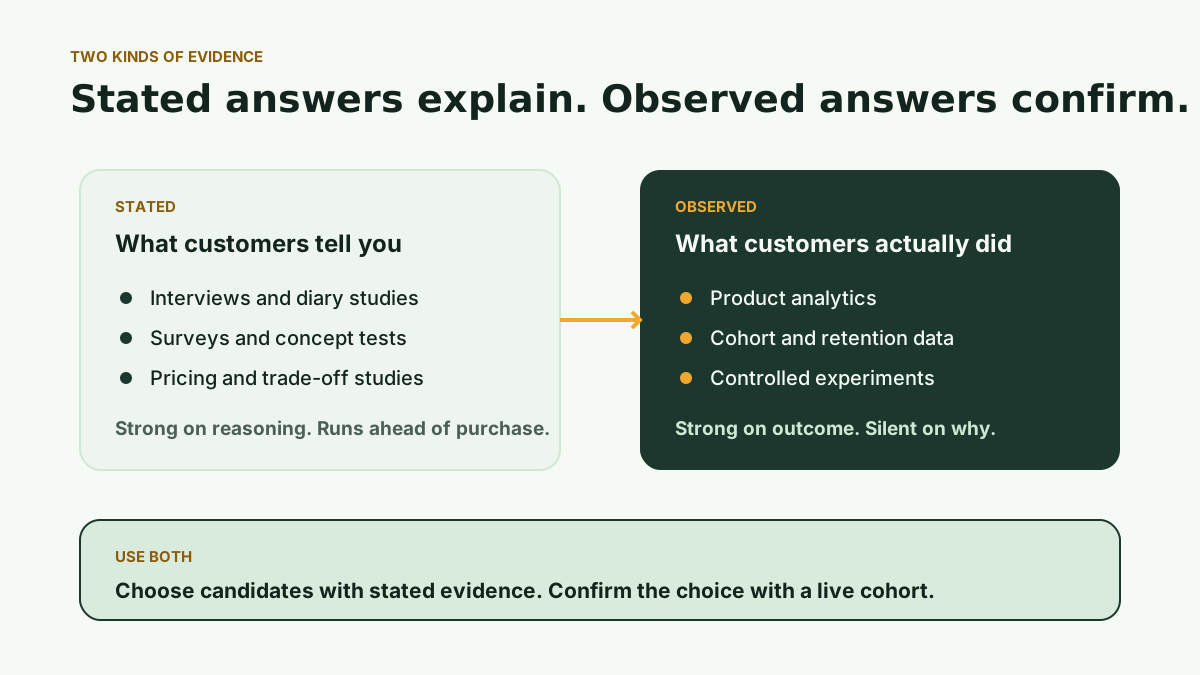
Two methods can study the same customer and disagree. That happens often, and it is not a failure. Stated intent and observed behavior measure different things.
The methods worth knowing
Customer interviews
You talk to one customer at a time about their problem, their current workaround, and the job they hired your product to do. Interviews generate hypotheses, language, and surprises. They do not produce a number you can defend in a planning meeting.
Run five to twelve per segment. Stop when new interviews stop changing your understanding.
Contextual inquiry and field studies
You watch a customer work in their own environment. This surfaces the steps people never mention in an interview, including the spreadsheet they keep on the side and the two tools they switch between.
Expensive per participant. Strong when you suspect the stated workflow differs from the real one.
Diary studies
Customers record their own experience over days or weeks. Use this when the behavior you care about happens on a cadence that a one-hour session cannot capture, like a monthly close or a weekly report.
Usability testing
You give a customer a task and watch where they get stuck. Five participants surface most of the severe problems in a single interface. Usability testing tells you whether people can complete something. It does not tell you whether they want it.
Surveys
A survey collects the same predetermined questions from a larger group. It scales, it produces counts, and it fails quietly when the questions are vague or the audience is wrong.
Surveys measure attitudes well and predict behavior poorly. Write questions that ask about a concrete recent event rather than a hypothetical future one.
Card sorting and tree testing
Card sorting asks customers to group concepts the way they think about them. Tree testing checks whether people can find something in your proposed structure. Both support naming, navigation, and packaging decisions.
Analytics and clickstream
Your product already records behavior. Feature adoption, activation paths, and drop-off points cost nothing extra to read. Analytics answers what happened and stays silent on why.
A/B testing
You expose two groups to different versions and compare a measured outcome. This is the strongest evidence available for a live change, and it requires enough traffic, a stable metric, and a change you are willing to ship to half your customers.
Concept testing
You show a description, mockup, or landing page and measure reaction before you build. Useful early. Sensitive to how you write the description.
Pricing research methods
Pricing has its own family of quantitative attitudinal methods, each built for a different pricing question:
- Van Westendorp produces an acceptable price range from four perception questions.
- Gabor-Granger tests purchase intent at specific price points and models revenue across them.
- MaxDiff forces repeated most-and-least-important choices to rank features, messages, or claims.
- Conjoint analysis presents realistic packages so customers trade price against features, then estimates how each attribute drives choice.
These methods share a discipline the softer techniques lack. They constrain the answer format, so the analysis produces numbers rather than impressions.
Techniques that make any method work
The method names the instrument. These techniques decide whether the instrument reads anything true.
Screen for the buying context, not for enthusiasm. A respondent who cannot make or influence the purchase gives you an answer with no weight behind it. Ask four screening questions: does this person face the problem, understand the category, influence the purchase, and match the customer you want to serve.
Hold the offer constant. Every respondent should see the same product description, billing period, currency, included limits, and support level. A customer imagining a self-serve tool and a customer imagining onboarding and a success manager will answer the same price question differently.
Ask about the past, not the future. "How many times did you export a report last month" beats "how often would you use exports."
Separate the recruiting from the instrument. Weak recruiting cannot be repaired by a larger sample. A hundred responses from the wrong audience is a hundred wrong responses.
Pilot with five people before you launch to five hundred. You will find one confusing question every time.
Write the decision rule before you see the data. Record what result would change your plan. Teams that skip this step tend to find support for the conclusion they already held.
Match the method to the decision
| Decision you owe | Method that produces evidence | | --- | --- | | Understand a problem you cannot yet describe | Interviews, contextual inquiry | | Learn how the workflow really runs | Field study, diary study | | Decide whether people can use the thing | Usability testing | | Rank features or messages | MaxDiff | | Find an acceptable price range | Van Westendorp | | Choose between candidate price points | Gabor-Granger | | Design or compare packages | Conjoint analysis | | Measure a live change | A/B test, cohort analysis | | Size how common a behavior is | Survey, analytics |
Most real projects use two methods in sequence. Interviews shape the options, and a quantitative study chooses among them.
How many customers do you need
Sample size follows the method, not a rule of thumb.
Qualitative work saturates. Five to twelve interviews per segment usually exposes the recurring patterns, and five participants find most severe usability problems.
Quantitative work needs enough responses to make a difference readable rather than noisy. A pricing study aiming at a directional range for one segment can work in the low hundreds. A study that must split results across four segments needs enough responses inside each one.
Report the confidence band with the estimate. A single number with no interval invites false precision.
Five mistakes that waste a study
Asking customers to name a price. People are poor at pricing a product cold. Structured methods ask about perception, intent, or trade-off, then derive the number.
Recruiting a broad audience for a narrow question. Founders, growth people, and curious strangers can all answer. Only your buyer's answer counts.
Running one method and treating it as the whole answer. Van Westendorp gives a range. It does not give a revenue forecast. Analytics gives behavior. It does not give a reason.
Skipping validation rules. In a four-question price study, each respondent's answers should run too cheap, bargain, expensive, too expensive. Answers that break that order signal confusion, and repairing them by guessing corrupts the result.
Ending at the chart. Record the decision, the owner, the date, and the outcome you will watch. Research that stops at a deck gets rediscovered a year later and re-litigated from scratch.
Turn research into a recorded decision
A finished study should leave four artifacts behind: the question you asked, the evidence you collected, the decision you made, and the metric you will check in ninety days.
Kinetic Workspace keeps that record attached to the study that produced it, so the next pricing conversation starts from evidence rather than memory.
Run a customer research study on your own audience
Kinetic Pricing runs four self-serve study methods on customers you recruit yourself: Advanced Van Westendorp at $149, Gabor-Granger at $199, MaxDiff at $279, and CBC Conjoint at $499. You describe the product and segment, send the generated survey link to your own users, and receive deterministic analysis with a written decision narrative that gets code-checked against the math.
Kinetic Pro includes unlimited customer-recruited studies across all four methods, three seats, and Kinetic Workspace for $99 per month or $990 per year.
Choose a study method when your next decision needs customer evidence instead of another opinion.