
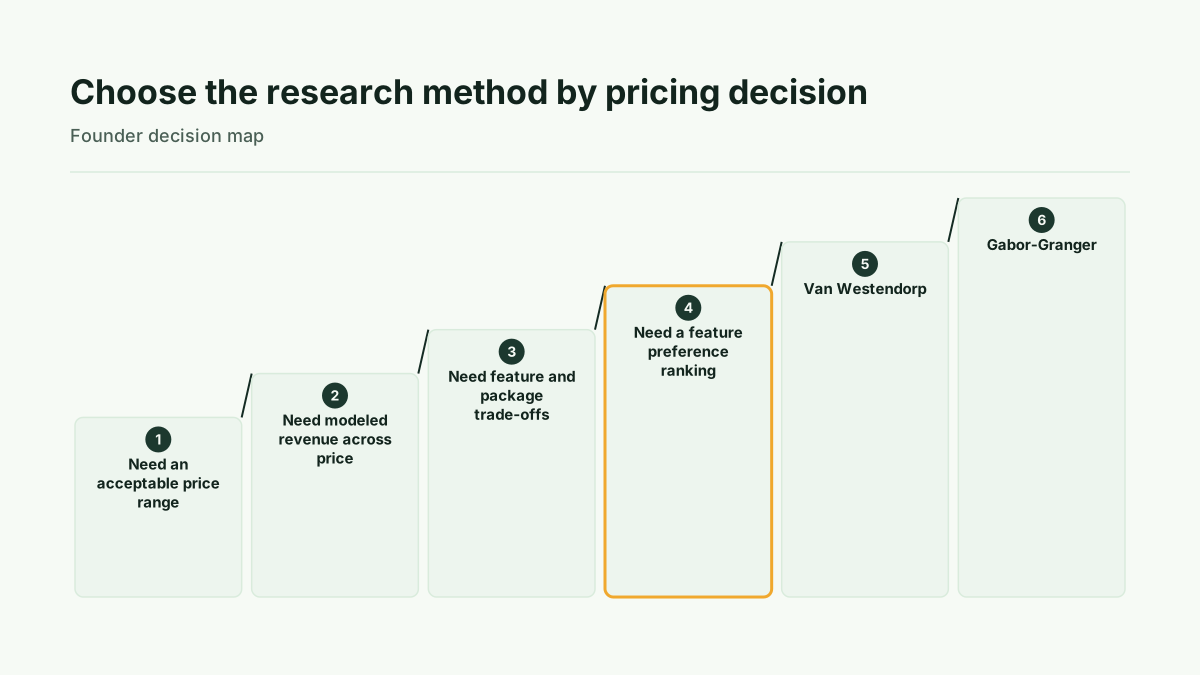
Choose a specialized pricing research platform rather than a general form builder when the goal is a defensible pricing decision. Use Van Westendorp to discover an acceptable price range, Gabor-Granger to compare price points and modeled revenue, conjoint when price and features interact, and MaxDiff when the decision is feature prioritization. The recommended sequence is Van Westendorp first, followed by Gabor-Granger, with conjoint or MaxDiff added only when the decision requires them.
What a pricing research platform must do beyond Typeform
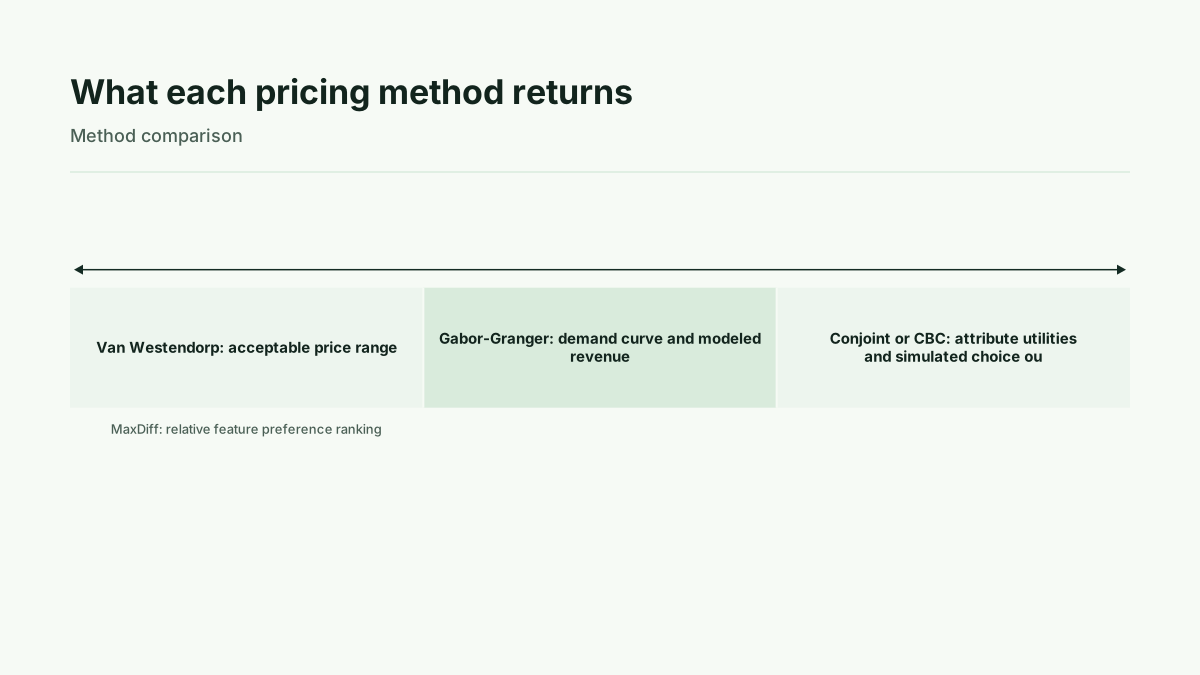
A general form builder primarily handles survey collection. A specialized pricing research platform can combine Van Westendorp, Gabor-Granger, conjoint or CBC, and MaxDiff in one pricing workflow. That distinction matters because the research method determines the output. A form can collect answers, but the pricing decision may require a price range, a demand curve, a package comparison, or a feature ranking. Kineticpricing describes the specialized workflow and its available pricing research methods.
Evaluate a platform against five practical requirements:
- Native method support: Can the tool run the method that matches the decision, rather than forcing a general question format?
- Analysis and scenario modeling: Can it turn responses into the relevant range, curve, utilities, ranking, or modeled comparison?
- Fielding controls: Can it support quality checks and randomized price exposure where the research design requires them?
- Raw response access: Can the team retain individual-level responses for review and further analysis?
- Security and operations: Can founders understand how the study is run, reviewed, and stored?
These criteria keep the comparison focused on evidence quality rather than survey appearance. The right alternative is the one that produces decision-relevant evidence with the least unnecessary complexity.
Match the pricing method to the decision
Van Westendorp is the starting point when the question is, “What price range appears acceptable?” It uses four open-ended price questions and produces price-perception intersections such as PMC, OPP, PME, and IDP. Its output is a price range, not a revenue estimate. See the method overview in A look at three survey-based methods for pricing research | Quirks.
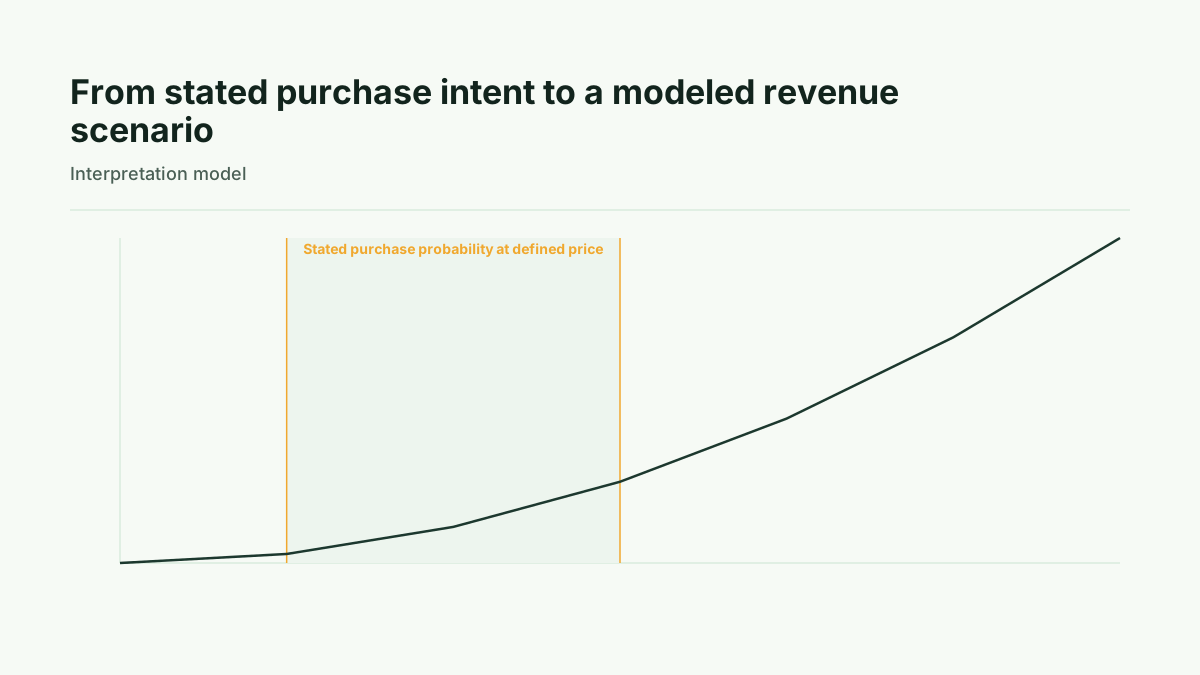
Gabor-Granger fits the question, “How does stated purchase likelihood change across the prices we are considering?” Respondents assess purchase likelihood at researcher-defined price points. The responses can produce a demand curve and a modeled revenue comparison. This makes it a logical follow-on after range discovery, because the acceptable range can inform the prices tested. The recommended sequence is also summarized by Run Van Westendorp first to establish your acceptable range, then use that range to set the price points for Gabor-Granger.
Conjoint or CBC is appropriate when price cannot be separated from product attributes. It evaluates price alongside features or package attributes and can estimate attribute utilities, feature-level willingness to pay, and simulated market outcomes. The output helps with package and configuration trade-offs, not just a single price recommendation.
MaxDiff answers a different question: which features or benefits should be prioritized relative to one another? It produces a relative feature preference ranking. Because that ranking is not a direct price recommendation, it is best used when the product decision is about emphasis, packaging inputs, or feature prioritization.
The decision rule is simple: use the least complex method that answers the question. Do not use a feature-ranking method to answer a revenue question, and do not expect a range-finding method to estimate revenue.
A practical workflow from hypothesis to pricing decision
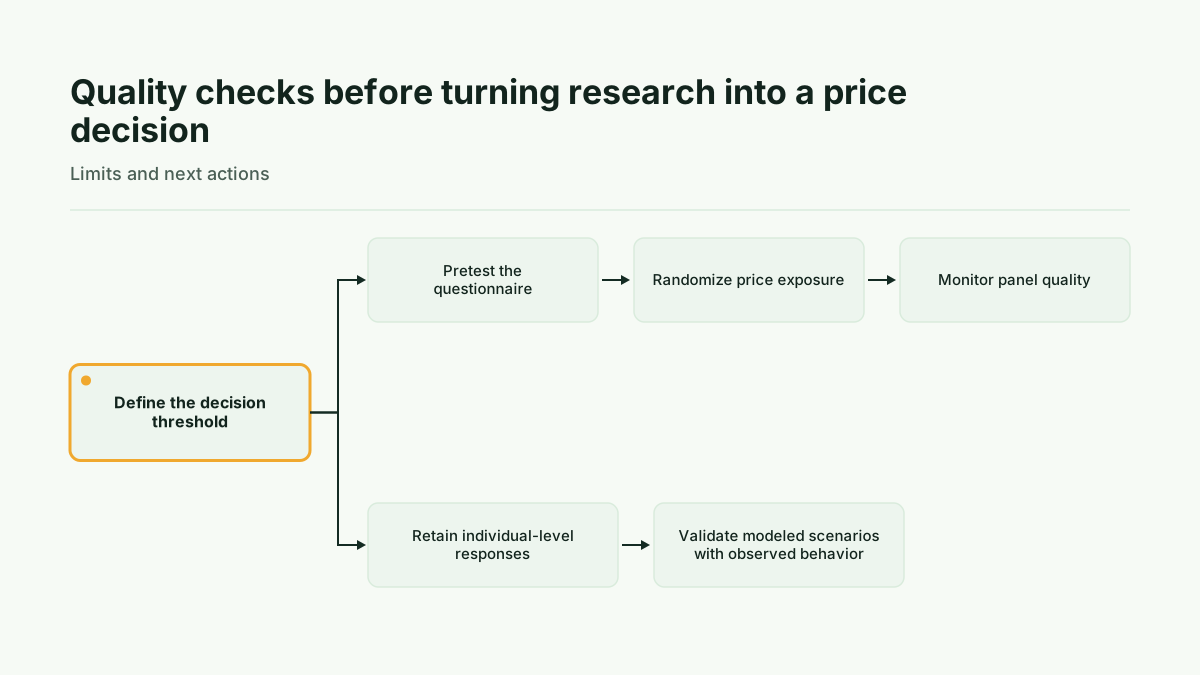
Begin by writing the decision as a testable hypothesis. For example, the team may need to decide whether a proposed range is acceptable, which of several prices deserves a market test, or which feature combination belongs in a package. Define the threshold for action before reviewing the results. Without a threshold, a study can produce information without producing a decision.
Next, select the sample that represents the intended buyer, write and pretest the questionnaire, and then field it with quality controls. Questionnaire wording should make the product, buyer, billing unit, and price context clear. The pricing survey question design guide is a useful reference for that preparation step.
For price-point research, randomize price-point order where appropriate and use quality checks to reduce or identify anchoring and inattentive-response risks in online research. These controls do not make stated intent equivalent to observed behavior. They improve the ability to identify response problems before interpretation. The evidence on multiple discrete choices provides context for online pricing bias and declaration methods.
After fielding, inspect the response data, apply the selected method, and model the scenarios relevant to the decision. Preserve the distinction between a stated response, a modeled result, and an observed transaction. Then compare the output with the threshold defined at the beginning. The result should specify what the research supports, what remains uncertain, and what market test could validate the decision.
How to interpret stated willingness to pay without overclaiming
Survey-based willingness to pay measures stated intent. A respondent’s stated purchase likelihood at a defined price is not an observed purchase. A demand curve derived from those answers is a modeled representation of intent, and revenue calculated from that curve is a modeled or simulated scenario. It is not a guaranteed forecast.
A useful interpretation chain is:
- Stated purchase intent: what respondents say they might buy at a defined price.
- Modeled demand: a curve or comparison derived from those responses.
- Modeled revenue: a scenario that combines modeled demand with an addressable-market assumption or other stated modeling inputs.
- Observed behavior: transactions or market-test results, which remain separate evidence.
Hypothetical bias is therefore a central limit. Sample quality, questionnaire design, price-point selection, randomization, and response attention can all affect the result. Practitioners should treat survey outputs as inputs to scenario modeling and validate them with market tests where feasible, as discussed in Practitioners should treat survey outputs as inputs to scenario modeling and validate with market tests where feasible.
Platform costs, timelines, and vendor checks
A founder comparing vendors should ask what is included in the study or subscription, which methods are native, how raw responses are exported, and what controls are available during fielding. Ask whether the output is a range, a demand curve, a feature ranking, attribute utilities, or a simulated choice result. Also ask which assumptions are required to turn the output into a scenario.
Kinetic Pricing’s listed product facts separate the methods into distinct options: the Price range finder is listed at 14900 cents, the Price point tester at 19900 cents, the Feature value ranker at 27900 cents, and the Package and price builder at 49900 cents. Kinetic Pricing Pro is listed at 9900 cents per month or 99000 cents per year, with a 30-day trial. These are product and plan facts, not evidence of a particular research outcome.
A vendor check should also cover sample sourcing, respondent screening, questionnaire review, data retention, analysis transparency, and the boundary between modeled results and observed behavior. If a provider cannot explain the method’s output and limitations in plain language, the platform may add presentation without adding decision quality.
When Kinetic Pricing is the better Typeform alternative
Kinetic Pricing is the better fit when the founder’s decision requires native pricing methods rather than general survey collection. Its listed research options map directly to the decision sequence: the Price range finder supports range discovery, the Price point tester supports price-point analysis, the Feature value ranker supports feature prioritization, and the Package and price builder supports package and price trade-offs.
That mapping does not imply that every study needs every method. A focused range question may need only Van Westendorp. A price decision requiring modeled comparisons may add Gabor-Granger. A package decision may require conjoint, while a feature prioritization decision may require MaxDiff. Choose the method sequence based on the decision threshold and evidence requirement.
Method
This article uses the supplied verified claims to translate a method comparison into a founder-focused workflow. It begins with the primary decision, maps each method to its stated output, and then separates fielding controls, scenario modeling, and observed validation. Material method and product claims are linked to the supplied evidence, while product prices are stated with explicit units.
Interpretation
Platform choice should follow the pricing decision, not the survey format. Van Westendorp identifies an acceptable range but does not estimate revenue. Gabor-Granger supports a demand curve and modeled revenue comparison across researcher-defined prices. Conjoint evaluates feature and price trade-offs. MaxDiff ranks feature preferences but does not directly produce a price recommendation. Any revenue result derived from survey responses is a modeled scenario until validated against observed transactions.
Limits
The evidence supports survey-based methods and platform capabilities, but it does not establish causal pricing effects, observed conversion outcomes, or universal sample-size rules. Stated willingness to pay can differ from real purchasing behavior. Results depend on sample quality, questionnaire design, price-point selection, randomization, segmentation, and the decision threshold defined before analysis. A platform can organize the research workflow, but it does not eliminate hypothetical bias or turn modeled revenue into observed performance.
Next step
Define the pricing decision and minimum evidence threshold before choosing a tool. If the decision is range discovery, begin with Van Westendorp. If it requires a revenue comparison, follow with Gabor-Granger. Add conjoint for feature-package trade-offs and MaxDiff for feature prioritization. Review Kinetic Pricing plans when comparing the available study and subscription options.
Additional context on these methods is available from Conjoint studies typically require 300–800 respondents and 3–8 minutes for pricing tasks, Run Van Westendorp first to establish your acceptable range, then use that range to set the price points for Gabor‑Granger, $149 one-time study option and a $99/month Pro subscription, self-serve pricing research guide, Review sample research outputs and benchmarks, Empirical evaluation of bias induced by four declaration methods in online pricing data | Journal of Product & Brand Management (Emerald), Internet surveys and hypothetical bias mitigation tools (Howard) | ECU economics and Van Westendorp vs Gabor-Granger: Which to Choose | Quali‑Fi.
Run this method with your users
Start 30-day free trial to run every method with your users, or Buy one study when one decision needs evidence now.
Sources
Quali-Fi, “Van Westendorp vs Gabor-Granger: Which to Choose”
Howard, “Internet surveys and hypothetical bias mitigation tools,” ECU economics
Journal of Product and Brand Management, “Empirical evaluation of bias induced by four declaration methods in online pricing data”
Quirks, “A look at three survey-based methods for pricing research”