
Choose MaxDiff when the decision is to rank standalone items such as features, messages, names, or claims. Choose conjoint when the decision requires trade-offs among attributes, prices, or product packages. Use a hybrid sequence when a long feature list must first be narrowed and the shortlist then needs package or pricing analysis.
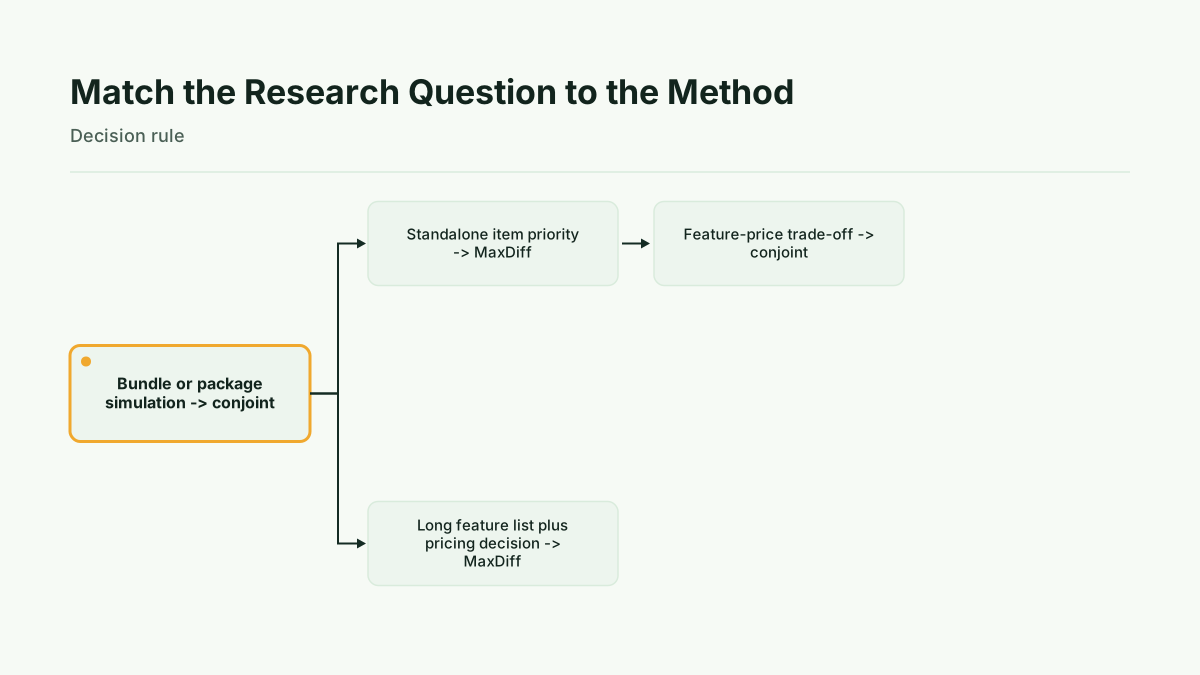
That is the central distinction: MaxDiff prioritizes items, while conjoint models choices among complete product profiles. Neither method is universally better. The right choice depends on the decision the study must support.
Start With the Business Question
Begin by writing one decision in plain language. If the team needs to know which standalone items matter most, MaxDiff is the closer fit. MaxDiff, also called Best-Worst Scaling, asks respondents to select the most and least preferred item from repeated sets and produces relative preference scores when modeled appropriately. Displayr’s MaxDiff primer describes this best-worst structure and its scoring logic.
If the decision is about combinations, price, or package design, use conjoint. Choice-based conjoint presents complete product profiles and estimates part-worth utilities for attribute levels. When price is included as an attribute, the method can analyze trade-offs involving price. The SAS conjoint technical note provides the relevant background on profiles, utilities, and attribute trade-offs. SAS conjoint technical note
If both decisions matter, sequence the methods rather than forcing one study to do both jobs. Use MaxDiff to narrow a long list, then carry the shortlisted attributes into a price-inclusive conjoint. This separates item prioritization from package optimization. Kicue’s MaxDiff design guide describes this MaxDiff-to-conjoint workflow.
What MaxDiff Measures
A MaxDiff task shows a respondent a set of items and asks for the most and least preferred item. Across repeated sets, the resulting data can be modeled into relative preference scores. The scores help a team distinguish higher-priority items from lower-priority items within the tested list. MaxDiff is also known as Best-Worst Scaling.
This makes MaxDiff useful for a moderate list of standalone features, messages, names, or claims. It answers a prioritization question: which items should receive more attention relative to the other items in the study? A product team can use that output to create a shortlist for a later package or pricing exercise.
The boundary matters. MaxDiff does not estimate willingness to pay, and it does not model feature combinations in a bundle. A high relative preference score for one feature therefore should not be read as a price premium, a forecast of purchases, or evidence that the feature will work best in a particular package. Quali-Fi’s research guide discusses the method’s use and limitations.
What Conjoint Measures
Choice-based conjoint asks respondents to choose among complete product profiles. Each profile combines levels of several attributes, which lets the study examine trade-offs rather than isolated item rankings. The estimated part-worth utilities describe the relative contribution of attribute levels within the tested design. SAS’s conjoint technical note documents this profile-based approach.
Conjoint can include price as an attribute. That enables analysis of price sensitivity alongside other product characteristics and can support willingness-to-pay calculations. It can also support simulated market-share or revenue scenarios. These outputs are modeled or stated-preference results, not observed purchase behavior. A simulated revenue result is not the same thing as revenue recorded after launch, and stated willingness to pay is not the same thing as a completed transaction.
Conjoint is therefore the better fit when the decision sounds like: Which package is preferred? How does a change in price alter modeled choice? Which combination of features creates the strongest modeled proposition? The study must define attributes and levels carefully enough that the profiles represent plausible alternatives.
Compare the Methods on the Decision That Matters
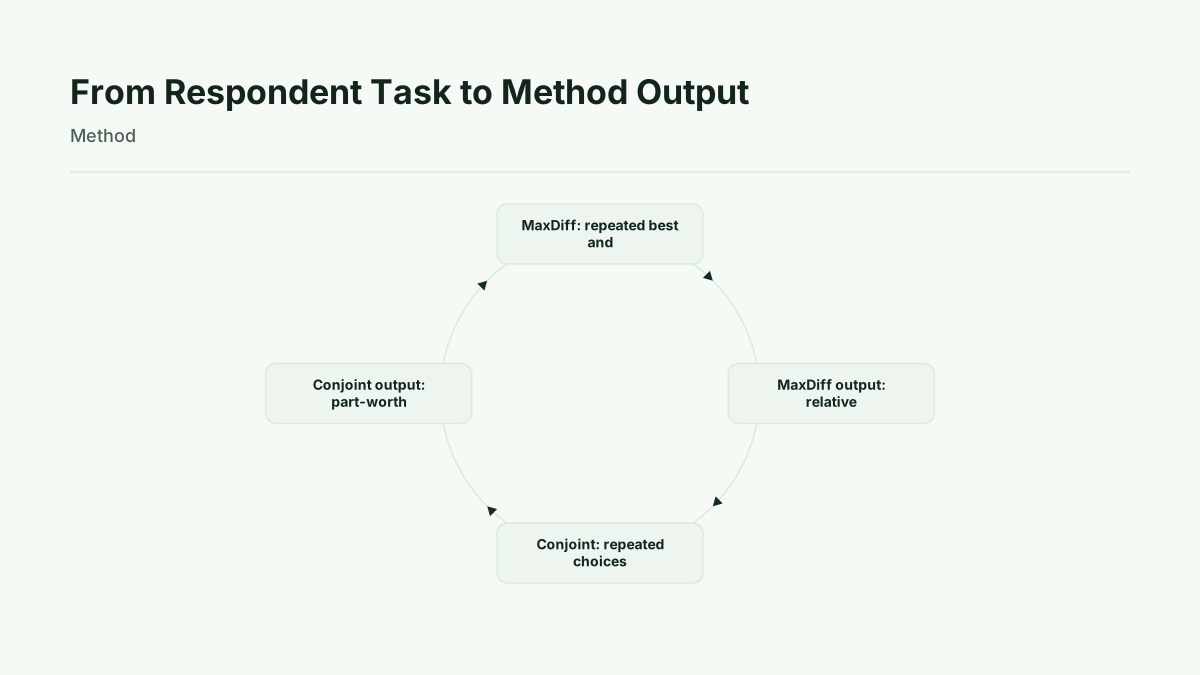
The respondent task is the first practical difference. MaxDiff uses repeated best-worst selections from item sets. Conjoint uses repeated choices among complete profiles. The output should determine the method, not the other way around.
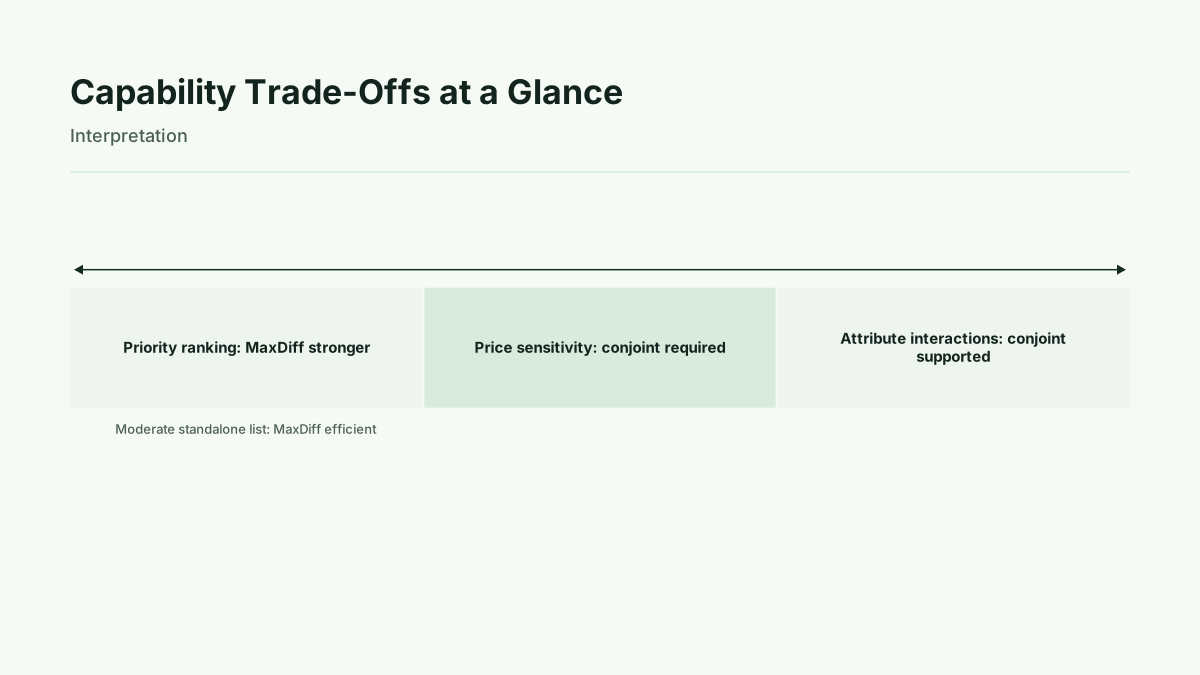
For a standalone priority list, MaxDiff produces relative preference scores suited to ranking. For feature-price trade-offs, conjoint produces part-worth utilities and can support price-related calculations when price is included. For package or bundle questions, conjoint is the relevant modeling path because the profiles represent combinations of attribute levels. MaxDiff is not a substitute for that bundle analysis.
The methods also differ in what they are not designed to answer. MaxDiff is unsuitable when the required output is willingness to pay or a modeled response to a specific bundle. Conjoint is unsuitable when the team has not yet decided which attributes belong in the package analysis and is asking only for a clean ranking of a longer list. In that case, a preliminary MaxDiff can reduce the list before conjoint.
Do not treat the comparison as a contest over a universal winner. Ask four questions instead:
- Are the inputs standalone items or multi-attribute profiles?
- Is price required as part of the decision?
- Does the team need a ranking, a trade-off model, or both?
- Will the output be preference scores, part-worth utilities, or modeled scenarios?
The answers provide the selection rule.
When the Hybrid Sequence Is Worth the Extra Study
A hybrid sequence is justified when the feature list is too long for the final package study but the business decision still requires pricing or bundle analysis. The first stage uses MaxDiff to narrow the list. The second stage uses the shortlist as input to a conjoint study that includes attributes and price.
This sequence prevents two different questions from being blurred together. MaxDiff asks which standalone items deserve priority. Conjoint asks how shortlisted attributes and price work together in modeled choices. The output from the first stage is a shortlist, not a price estimate. The output from the second stage can include part-worth utilities and modeled scenarios, but those remain stated-preference or modeled outputs.
Use both methods only when both decisions are real. If the team needs only a priority ranking, conjoint adds complexity without answering a necessary question. If the team already has a stable, short attribute list and needs package or pricing analysis, start with conjoint.
Method: Design the Smallest Study That Can Answer the Question
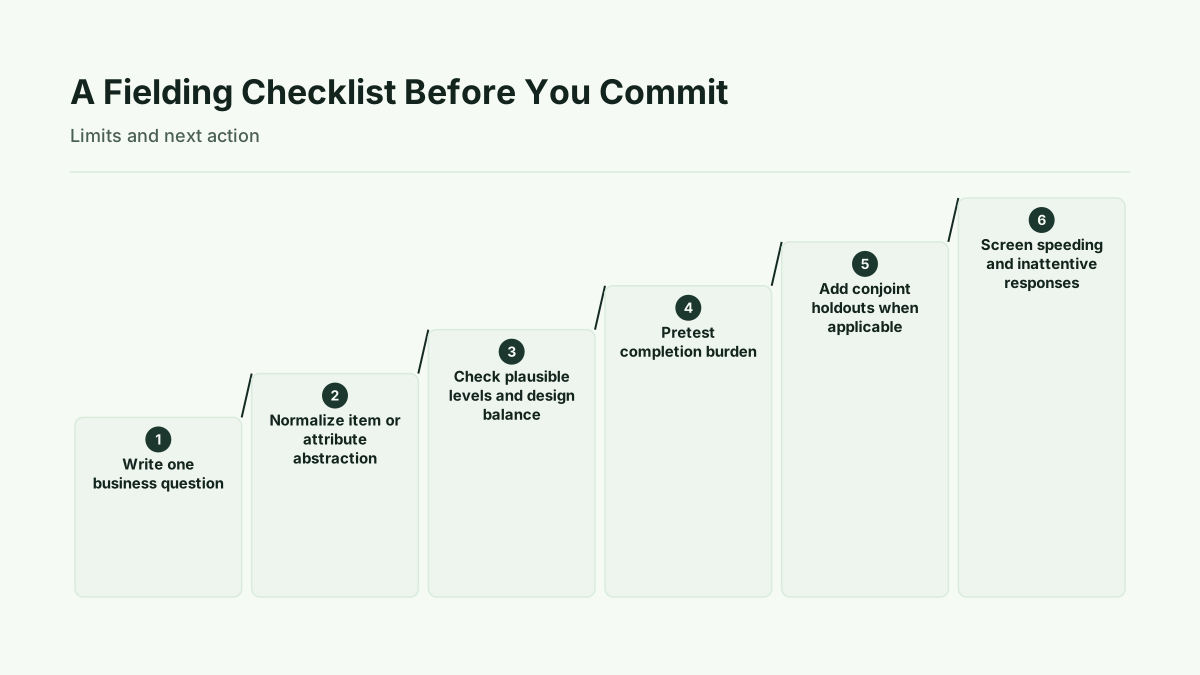
First, count the standalone items or the attributes and levels that the study must evaluate. Keep the abstraction level consistent. A list that mixes broad product benefits, detailed interface features, and complete packages can make the resulting preference comparison difficult to interpret.
For MaxDiff, confirm that the list is large enough to require prioritization but still coherent. For conjoint, confirm that each attribute has plausible levels and that the profiles represent choices a respondent can understand. Document the task wording, the number and structure of choice sets, the design approach, and the planned estimator before fielding.
Balanced or efficient experimental designs are important safeguards. Pretesting can expose confusing wording and excessive completion burden. For conjoint, holdout tasks provide a check on the estimated model against choices that were not used in estimation. Data-quality checks should address speeding, inattentive responses, and other prespecified response patterns. These safeguards are supported in the MaxDiff research guidance and SAS conjoint material. Quali-Fi’s research guide and SAS conjoint technical note provide design context.
Do not treat a sample-size recommendation as a universal power calculation. The required design depends on the question, the number of items or attributes, the estimand, and the planned analysis. Specify those elements before deciding whether the study is ready to field.
Interpretation: Report Preference, Stated Intent, and Modeled Outcomes Separately
Label each result by what it represents. A MaxDiff preference score is a relative ranking signal among the tested items. A conjoint part-worth is an estimated utility for an attribute level within the specified model. A willingness-to-pay estimate is calculated from the model and should be reported with its uncertainty. Simulated share and simulated revenue are scenario outputs from the model.
None of these should be presented as observed purchase behavior. Use confidence intervals where the analysis supports them, and add a plain-language summary that states the decision implication without changing the evidence type. For example, say that one item ranked ahead of another in stated preference, or that a modeled scenario produced a higher simulated share under the study assumptions. Do not rewrite either result as proof of market adoption.
Limits: Know When Neither Method Fits
Neither method fixes an unclear business question. MaxDiff can weaken when there are too few items to rank meaningfully or when the list mixes incompatible abstraction levels. It cannot answer a willingness-to-pay or bundle-interaction question.
Conjoint can weaken when there are too many attributes, implausible levels, or inefficient choice designs. Missing holdouts, weak pretesting, and inattentive respondents can also reduce confidence in the conclusions. Respondent heterogeneity may matter when different groups value the same attributes differently, so the reporting plan should state how such differences will be handled.
These methods are also not the answer to every research problem. Qualitative questions require a different kind of inquiry. Threshold-pricing questions may require a pricing test designed specifically for thresholds. And available transaction data can provide observed behavior that stated-preference methods do not provide. Keep observed, stated, and modeled evidence distinct.
Next Step: Turn the Decision Into a Fielding Plan
Write one business question. Count the standalone items or the attributes and levels. Confirm whether price is required. Choose MaxDiff for ranking, conjoint for trade-offs and packages, or the hybrid sequence when both prioritization and pricing analysis are necessary. Then prepare the task wording, experimental design, pretest, quality checks, and interpretation plan before fielding.
If the study needs a practical pricing workflow after method selection, Explore Kinetic Pricing plans to review the available research paths.
Additional context on these methods is available from MaxDiff study, Displayr's MaxDiff primer, Quali-Fi's research guide, SaaS package comparison, Kicue's MaxDiff design guide, pricing survey question design, testing SaaS pricing, Kineticpricing's founder guide to self-serve pricing research, SaaS pricing benchmarks, Kineticpricing Pro, MaxDiff — Wikipedia, MaxDiff Analysis: Complete Guide for Researchers | Quali‑Fi, MaxDiff (Maximum Difference Scaling) Design Guide — Measuring Priorities | Kicue and What is MaxDiff? Understanding Best-Worst Scaling - Displayr.
Run this method with your users
Start 30-day free trial to run every method with your users, or Buy one study when one decision needs evidence now.
Sources
- Displayr, “What is MaxDiff? Understanding Best-Worst Scaling”
- Quali-Fi, “MaxDiff Analysis: Complete Guide for Researchers”
- SAS, “Conjoint Analysis technical note”
- Kicue, “MaxDiff design guide”
- Wikipedia, “MaxDiff”